† Saint Quote
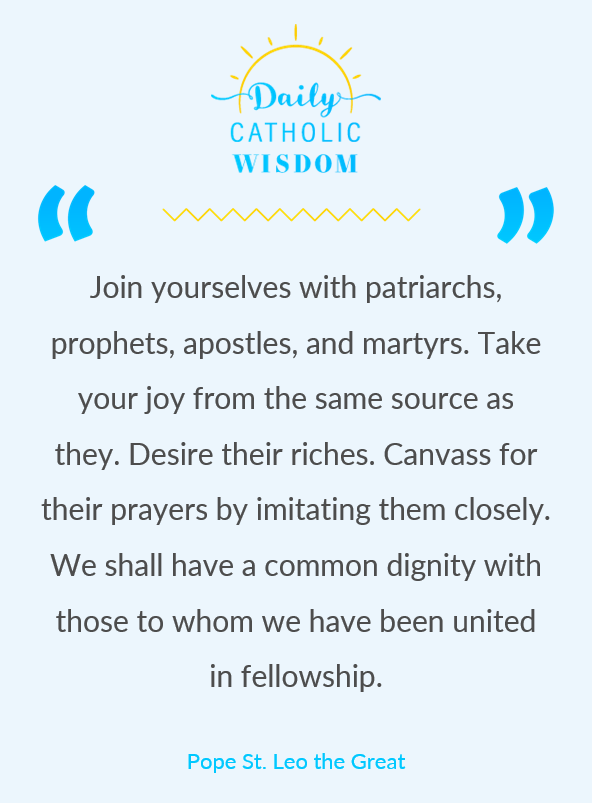
No one, however weak, is denied a share in the victory of the cross. No one is beyond the help of the prayer of Christ.
▪ St. Leo the Great
Today's Meditation
“Voluntary poverty restores to man the nobility of his condition, liberating him from vile servitude and reinstating him his noble freedom and mastery of all things. The soul is never more a mistress than when she despises them, and only then has she the more firm possession and makes the more excellent use of riches, when she gives them away or leaves them of her own free will; only then her appetite for them is best satiated, when she does not care to possess them. Then above all is the heart set free and made capable of the treasures of the Divinity, for which it is furnished by the Creator with almost infinite capacity.”
—Ven. Mary of Agreda, p. 85
Daily Verse †
But thou, O Lord, knowest me; thou seest me, and triest my mind toward thee.
▪ Jeremiah 12:3a
|
EWTN Daily Saint
|
|
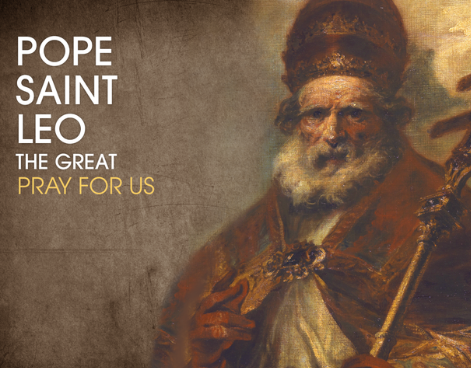
Pope St. Leo the Great
Patron Saint of: Popes, theologians, and Rome
Feast Day: November 10
Pope St. Leo the Great (c. 400–461 A.D.) was born in Tuscany to an aristocratic family. After serving as deacon under two popes he became the Roman Pontiff from 440 to 461 A.D. He was one of the greatest Holy Fathers the Church has known; he was the first pope, and one of only two, to bear the title “Great.” He guided the Church through the turbulence of the collapse of the Roman empire, waves of barbarian invasions, widespread disintegration of morality, and many dangerous heresies including Pelagianism and Manichaeanism. His feats include persuading the Emperor Valentinian to recognize the primacy of the Bishop of Rome; preventing a doctrinal split in the Eastern churches; persuading Attila the Hun to turn back and forsake his invasion of Italy; and convincing the Vandals under their leader Genseric not to pillage the city of Rome or harm its inhabitants. He championed the Church and the Catholic faith in an uncertain era by maintaining unity, defending orthodox doctrine with clarity, and preaching vigorously against false teaching. By his strong influence he changed the course of European history; he was known not only as a leader of the Church but also as the protector of all of Rome. Pronounced a Doctor of the Church in 1754, many of his writings survive today. St. Leo the Great’s feast day is November 10th.
|
Memorial of Saint Leo the Great, Pope and Doctor of the Church
Lectionary: 492
Reading 1
Titus 2:1-8, 11-14
Beloved:
You must say what is consistent with sound doctrine,
namely, that older men should be temperate, dignified,
self-controlled, sound in faith, love, and endurance.
Similarly, older women should be reverent in their behavior,
not slanderers, not addicted to drink,
teaching what is good, so that they may train younger women
to love their husbands and children,
to be self-controlled, chaste, good homemakers,
under the control of their husbands,
so that the word of God may not be discredited.
Urge the younger men, similarly, to control themselves,
showing yourself as a model of good deeds in every respect,
with integrity in your teaching, dignity, and sound speech
that cannot be criticized,
so that the opponent will be put to shame
without anything bad to say about us.
For the grace of God has appeared, saving all
and training us to reject godless ways and worldly desires
and to live temperately, justly, and devoutly in this age,
as we await the blessed hope,
the appearance of the glory of the great God
and of our savior Jesus Christ,
who gave himself for us to deliver us from all lawlessness
and to cleanse for himself a people as his own,
eager to do what is good.
Responsorial Psalm
Psalm 37:3-4, 18 and 23, 27 and 29
R. (39a) The salvation of the just comes from the Lord.
Trust in the LORD and do good,
that you may dwell in the land and be fed in security.
Take delight in the LORD,
and he will grant you your heart’s requests.
R. The salvation of the just comes from the Lord.
The LORD watches over the lives of the wholehearted;
their inheritance lasts forever.
By the LORD are the steps of a man made firm,
and he approves his way.
R. The salvation of the just comes from the Lord.
Turn from evil and do good,
that you may abide forever;
The just shall possess the land
and dwell in it forever.
R. The salvation of the just comes from the Lord.
Alleluia
John 14:23
R. Alleluia, alleluia.
Whoever loves me will keep my word,
and my Father will love him,
and we will come to him.
R. Alleluia, alleluia.
Gospel
Luke 17:7-10
Jesus said to the Apostles:
“Who among you would say to your servant
who has just come in from plowing or tending sheep in the field,
‘Come here immediately and take your place at table’?
Would he not rather say to him,
‘Prepare something for me to eat.
Put on your apron and wait on me while I eat and drink.
You may eat and drink when I am finished’?
Is he grateful to that servant because he did what was commanded?
So should it be with you.
When you have done all you have been commanded, say,
‘We are unprofitable servants;
we have done what we were obliged to do.’”
|
Praise to You Oh Lord Jesus Christ!
|

From Word Among Us WAU.org
|
Daily Meditation: Luke 17:7-10
We are unprofitable servants. (Luke 17:10)
What a striking statement! Jesus tells us that, even after we have done everything expected of us, we remain “unprofitable servants”(Luke 17:10). Other versions translate “unprofitable” as “worthless” or “unworthy,” and the Greek root of the word speaks of being “unvaluable” servants.
That sounds like an awfully harsh way to describe such a faithful servant! What more does the master expect? What would make his servants “profitable”?
Nothing. And that’s Jesus’ point in the parable: there’s nothing we can do that will earn us the title of “profitable servants” of the Lord. Not because God rejects us for our sinfulness and not because he is a harsh and exacting Master, but because it’s just plain impossible. God is complete and perfect in and of himself. He needs nothing from us, so there is no “profit” he gains from our work. It’s not as if we can fill up his coffers!
Neither do we serve a God who feels indebted to us as if we were doing him a favor that deserves a hearty “Thank-you.” He doesn’t need us to do his work. Rather, he invites us to serve him so that we can know the joy of sharing his love with the people around us. He offers us the privilege of joining him in building his kingdom on earth.
If we could be profitable to him, then our worth would come from how much profit we bring in. And some would be more valuable to him than others. But that’s not how God sees us. Our worth comes only from the simple fact that he loves us. He doesn’t love some people more than others, and he doesn’t base his love on our performance.
Does this mean we don’t have to worry about obeying him as a servant obeys their master? Not at all! Everyone is called to do “what we were obliged to do” (Luke 17:10). But the calling is to serve him because we love him, not to convince him to love us.
So what kind of servant do you want to be? One who approaches God like an employee, constantly trying to do enough work to earn his praise? Or one who freely and joyfully takes up his calling to be a light to the world?
“Lord, it is a privilege to serve you!”
Titus 2:1-8, 11-14
Psalm 37:3-4, 18, 23, 27, 29
|
Reflections with Brother Adrian:
Audio Link
|

Click To Hear 2 Cents Audio
|
From today's Holy Gospel:
"Jesus said to the Apostles:
“Who among you would say to your servant
who has just come in from plowing or tending sheep in the field,
‘Come here immediately and take your place at table’?
Would he not rather say to him,
‘Prepare something for me to eat.
Put on your apron and wait on me while I eat and drink.
You may eat and drink when I am finished’? ”
|
From Roberto Juarez:
"Today's Gospel invites us to ask ourselves from what motivation we live our faith. Do we serve to be seen or because we want to love? Do we collaborate to receive recognition or because we feel part of a community? Do we do good by expecting a reward or because we have discovered that God's love deserves a response?
Let us ask the Lord to grant us a humble and generous heart, capable of serving without seeking prominence, of working without continually comparing ourselves with others and of recognizing that all that we are comes from his goodness. And that, at the end of each day, we may look at our lives with peace and say simply: we have tried to do what the Lord has asked of us." end quote.
- - -
Bishop Barron said: "Friends, today’s Gospel describes the obedience of a faithful servant. Our lives are not about us; they are about the King. We are built not for commanding others but for obedience. In the presence of the awesome lordliness of God—that mind and will whose grandeur we can barely fathom—we bow, we listen, we surrender.
The Lord is the King, the one who commands, directs, and oversees, and who, accordingly, demands obedience. For a military tribe such as the ancient Hebrews, this term had, to be sure, an especially powerful resonance. The proper response to a king is obedience. The king commands, and the servant responds—simply, promptly, unhesitatingly.
A courtier or a messenger might not understand the rationale for or consequences of what the king has told him to do, but he does it, trusting in the wisdom and power of the one who sends him. The word “obey” is derived from the Latin obedire, to listen attentively, to heed. In the presence of God the Lord, we his servants should listen, bending our ears and our wills to his word." end quote.
- - -
Your Brother Adrian.
In my many studies, and sharing with you here, we find the importance of one tremendous virtue…obedience.
In Catholic teaching, obedience is considered a distinct moral virtue related to justice.
Key Aspects of Obedience in Catholicism:
• Definition: It is the voluntary submission of one’s own will to a legitimate superior or to God’s will out of love, faith, and humility.
• Rooted in Christ: It is modeled after Jesus Christ, who submitted Himself to the Father's will ("not my will, but yours be done") and was obedient even unto death on the cross (Philippians 2:8).
• St. Thomas Aquinas's View: Aquinas places high significance on obedience among the moral virtues because it involves sacrificing one's own will—considered the highest good of the soul—for the sake of God.
And what a struggle it can be for us, for many, with obedience.
We have 10 commandments. And what a fiasco people make of it.
And so they are taken as the ten suggestions.
And then we have those that do what God says, and then expect a reward?
Demanding a reward. Demanding an answered prayer!
One of the hardest lessons I try to teach people…is humility.
But it shouldn't be hard. If we practice gratitude. If we practice reverence to God. If we learn how to be grateful and how to honor God…and there is perhaps no better place, than in the heart…to begin this love connection with LOVE, because the bible says that God IS LOVE.
Lord, like a thankless mother, we are to be for you. A servant, to teach servants. A model, like Mother Mary who taught our Lord the love of God, in Holy Obedience, as she told ArchAngel Gabriel: Not MY WILL, but YOURS be done!
|
Click for Audio
|
Random Bible Verse 1
Psalm 51:4
"Against you, you only, have I sinned
and done what is evil in your sight,
so that you may be justified in your words
and blameless in your judgment."
Word of the Lord!
|
If one day you don't receive these, just visit Going4th.com
God Bless You! Peace
|
|
|




No comments:
Post a Comment