† Saint Quote“He who wishes for anything but Christ, does not know what he wishes; he who asks for anything but Christ, does not know what he is asking; he who works, and not for Christ, does not know what he is doing.”
-St. Philip Neri Today’s Meditation"Do not suppose that after advancing the soul to such a state God abandons it so easily that it is light work for the devil to regain it. When His Majesty sees it leaving Him, He feels the loss so keenly that He gives it in many a way a thousand secret warnings which reveal to it the hidden danger. In conclusion, let us strive to make constant progress: we ought to feel great alarm if we do not find ourselves advancing, for without doubt the evil one must be planning to injure us in some way; it is impossible for a soul that has come to this state not to go still farther, for love is never idle. Therefore it is a very bad sign when one comes to a standstill in virtue." —St. Teresa of Avila, p.99
An excerpt from Interior Castle Daily VerseIn contrast, the fruit of the Spirit is love, joy, peace, patience, kindness, generosity, faithfulness, gentleness, self-control. Against such there is no law. Now those who belong to Christ [Jesus] have crucified their flesh with its passions and desires. If we live in the Spirit, let us also follow the Spirit. Let us not be conceited, provoking one another, envious of one another.
-Galatians 5:22-26
|

EWTN Daily Saint
|
|
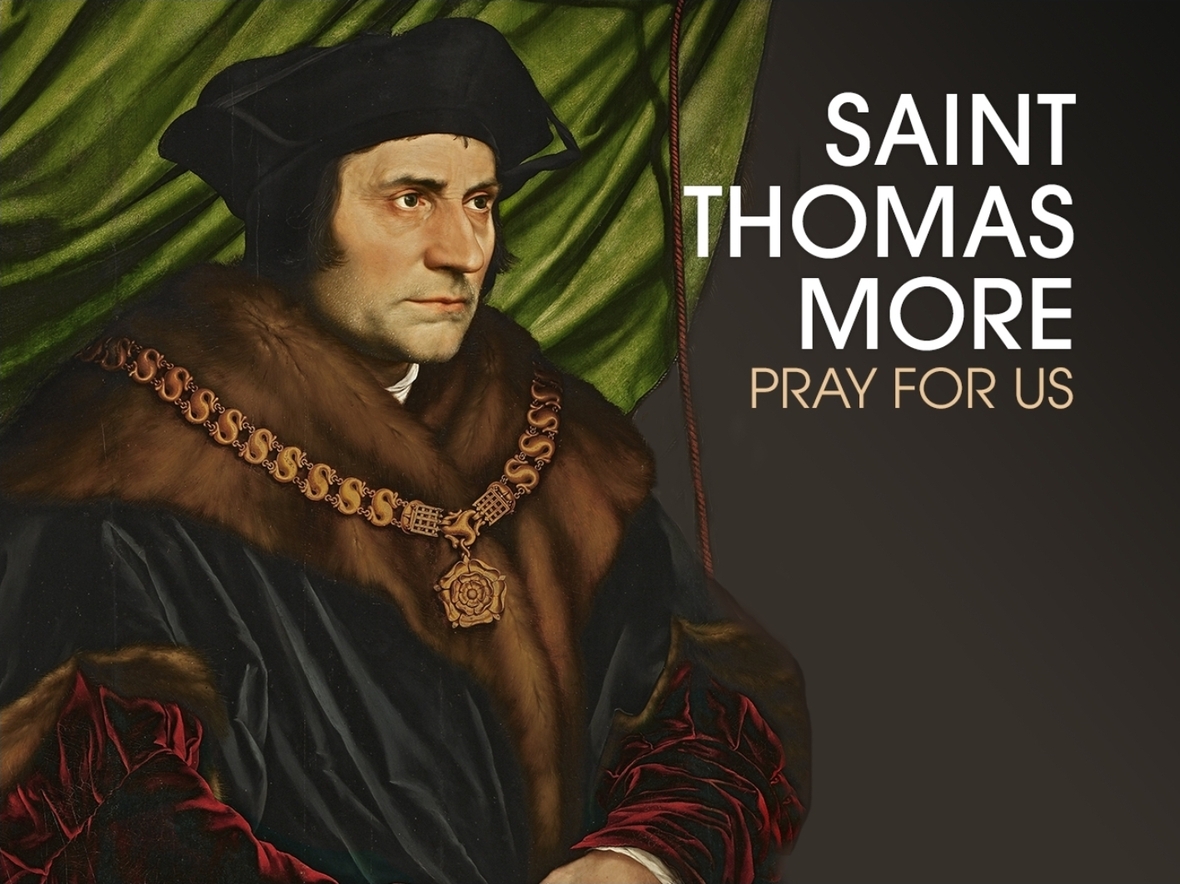
St Thomas MoreSt. Thomas More (1478–1535) was born in London, the son of a lawyer and judge. He was educated in the finest schools and became a brilliant English statesman. He served in parliament, on the King's council, as a diplomat, and in many other prominent positions in public administration. He was highly esteemed for his unfailing moral integrity, sharpness of mind, humor, and extraordinary learning. He was also a faithful Catholic, a loving husband, and a devoted father. For his great abilities he was promoted by his friend King Henry VIII to the high office of Lord Chancellor, second in position to the king. He resigned from this post when the king, in open defiance of Church teaching, sought to divorce his wife in order to marry another woman, and to declare himself sovereign of the Church in England. Thomas More, a defender against heresy, refused to condone the king's actions. After trying unsuccessfully to persuade his friend to approve of what he was doing, King Henry VIII imprisoned More in the Tower of London. At his trial, More testified boldly for Church autonomy over the state, for the authority of the pope as head of the Church, and for the indissolubility of marriage in the eyes of God. He was eventually condemned and beheaded, dying as a martyr for the Catholic faith. Thomas More is the patron saint of statesman, politicians, lawyers, civil servants, and large families. His feast day is June 22nd.
|
Monday of the Twelfth Week in Ordinary Time Reading I 2 Kings 17:5-8, 13-15a, 18Shalmaneser, king of Assyria, occupied the whole land
and attacked Samaria, which he besieged for three years.
In the ninth year of Hoshea, king of Israel
the king of Assyria took Samaria,
and deported the children of Israel to Assyria,
setting them in Halah, at the Habor, a river of Gozan,
and the cities of the Medes. This came about because the children of Israel sinned against the LORD,
their God, who had brought them up from the land of Egypt,
from under the domination of Pharaoh, king of Egypt,
and because they venerated other gods.
They followed the rites of the nations
whom the Lord had cleared out of the way of the children of Israel
and the kings of Israel whom they set up. And though the LORD warned Israel and Judah
by every prophet and seer,
“Give up your evil ways and keep my commandments and statutes,
in accordance with the entire law which I enjoined on your fathers
and which I sent you by my servants the prophets,”
they did not listen, but were as stiff-necked as their fathers,
who had not believed in the LORD, their God.
They rejected his statutes,
the covenant which he had made with their fathers,
and the warnings which he had given them, till,
in his great anger against Israel,
the LORD put them away out of his sight.
Only the tribe of Judah was left. Responsorial Psalm Psalm 60:3, 4-5, 12-13R. (7b) Help us with your right hand, O Lord, and answer us.
O God, you have rejected us and broken our defenses;
you have been angry; rally us! R. Help us with your right hand, O Lord, and answer us.
You have rocked the country and split it open;
repair the cracks in it, for it is tottering.
You have made your people feel hardships;
you have given us stupefying wine. R. Help us with your right hand, O Lord, and answer us.
Have not you, O God, rejected us,
so that you go not forth, O God, with our armies?
Give us aid against the foe,
for worthless is the help of men.
R. Help us with your right hand, O Lord, and answer us. Alleluia Hebrews 4:12R. Alleluia, alleluia.
The word of God is living and effective,
able to discern reflections and thoughts of the heart.
R. Alleluia, alleluia. Gospel Matthew 7:1-5Jesus said to his disciples:
“Stop judging, that you may not be judged.
For as you judge, so will you be judged,
and the measure with which you measure will be measured out to you.
Why do you notice the splinter in your brother’s eye,
but do not perceive the wooden beam in your own eye?
How can you say to your brother,
‘Let me remove that splinter from your eye,’
while the wooden beam is in your eye?
You hypocrite, remove the wooden beam from your eye first;
then you will see clearly
to remove the splinter from your brother’s eye.”
|
Praise to You Oh Lord Jesus Christ!
|

From Word Among Us WAU.org
|
Daily Meditation: Matthew 7:1-5Why do you . . . not perceive the wooden beam in your own eye? (Matthew 7:3) Why did Jesus use this strange metaphor about splinters and wooden beams as he warned his disciples against judging other people? He wanted to make a point. We know that even the tiniest irritant in our eye, much less a splinter, can disrupt our vision. Unfortunately, our tendency to judge other people is no mere splinter—it’s like a beam that keeps us from seeing straight! But imagine for a moment the way that Jesus looks at you. He’s not counting up your every sin; he’s offering you mercy. He doesn’t just see your flaws and your failures; he sees all that you can become. He looks on you with great compassion and mercy. He sees in you someone made in the image of his heavenly Father. It’s true; Jesus sees you through the eyes of his mercy and love—and not just you. This is how he looks upon everyone. Every single person is precious to him, and he longs for us to look at each other in the same way. Do you want a little more inspiration to let Jesus change the way you look at people? In today’s Gospel, Jesus says, “The measure with which you measure will be measured out to you” (Matthew 7:2). While Jesus looks upon us with compassion and mercy, he warns against “measuring” our compassion and mercy in a stingy way. It sounds similar to the Lord’s Prayer, when we pray, “Forgive us our trespasses as we forgive those who trespass against us.” So let’s examine our hearts. Let’s uproot and bring to the Lord the ways we tend to look down on other people or find it easy to point out their faults or refuse to give them the benefit of the doubt. Let’s come to the Lord to receive his forgiveness. When we allow his mercy to lead us to repentance, the “beam” is removed from our eyes, and our hearts are changed. Then we can begin to see differently. “Jesus, I bring to you anything that prevents me from seeing my neighbor clearly, as you see them, with eyes of mercy and compassion.” 2 Kings 17:5-8, 13-15, 18
Psalm 60:3-5, 12-13
|
Reflections with Brother Adrian:
|
From today's Holy Gospel: ".... Jesus said to his disciples:
“Stop judging, that you may not be judged.
For as you judge, so will you be judged, ... ”
|
From Bishop Barron: "
Friends, Jesus’s parable in today’s Gospel is one of the most psychologically and spiritually insightful remarks in the New Testament. Let’s face it: a favorite pastime of most human beings is criticism of others. We delight in pointing out the shortcomings, moral failings, and annoying tendencies of our neighbors. This is, of course, a function of pride and egotism: The more I put someone else down, the more elevated I feel. But it is also, oddly, a magnificent means of turning a mirror on ourselves, to see what usually remains unseen. Why, we ought to ask, do we find precisely this sin of others particularly annoying? Why does that trait or sin of a confrere especially gall us? Undoubtedly, Jesus implies, because it reminds us of a similar failing in ourselves. I remember a retreat director asking each of us to call to mind a person that we found hard to take and then to recount in detail the characteristics that made the person so obnoxious to us. Then he recommended that we go back to our room and ask God to forgive those same faults in ourselves. His words were as unnerving and as illuminating as these words of Jesus." End quote Bishop Barron.
Stop judging?
What does that mean? We all have to use our judgement for everything right?
But....our Lord says....use it for God's glory!
Use your judgement as He did...in the eyes of grace...and mercy.
Be merciful.
Be made perfect.
Bring souls to salvation!
|
Random Bible Verse 1
Psalm 104:1–2
[Psalm 104] O Lord My God, You Are Very Great
104 Bless the LORD, O my soul! O LORD my God, you are very great! You are clothed with splendor and majesty,
2 covering yourself with light as with a garment, stretching out the heavens like a tent.
Word of the Lord!
|
If one day you don't receive these, just visit Going4th.com
God Bless You! Peace
|
|
|