Quote: ""The life of the body is the soul; the life of the soul is God.""
-St. Anthony of Padua Today's Meditation "Much that is true of human relationships is also true of our relationship with God. Human relationships of friendship or marriage need time, attention, and care for them to continue and to grow. The same is true of our relationship with God. We have been called to union but we need to respond. As we turn to God in conversion or in a deeper awakening, besides turning away from deliberate sin—which deforms the soul, blocks the relationship and offends the Person who has sacrificed His life for us—we need to positively build the relationship by paying attention to the One who loves us. Prayer is at root simply paying attention to God." —Ralph Martin, p. 121
An excerpt from The Fulfillment of All Desire Daily Verse "He has showed you, O man, what is good; and what does the Lord require of you but to do justice, and to love kindness, and to walk humbly with your God?"
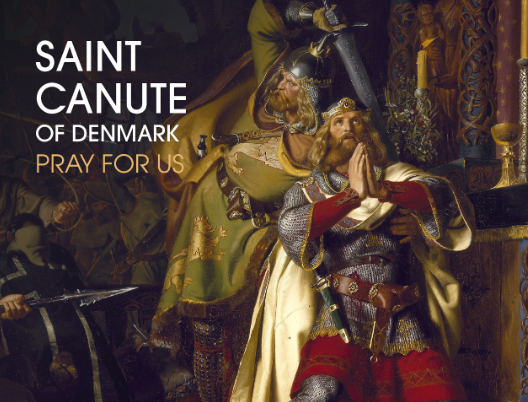
-Micah 6:8 | St Canute Iv Of Denmark St. Canute IV of Denmark (1042 – 1086 A.D.), also known as Canute the Holy, was one of thirteen sons born to the king of Denmark. Canute later succeeded his brother to the throne and reigned as king from 1080 to 1086. He was a devout Catholic, a zealous propagator of the faith, and a brave warrior, in addition to being a man of prayer, penance, austerity, and charity towards the poor and weak among his people. The happiness of his people and the interests of the Church were his motivation, often putting him in opposition to the aristocracy. He fought against the barbarian nations and worked to strengthen the power of the monarchy, but some of his laws were unpopular and caused unrest among the people. Canute sought to expand Denmak's territory and believed he had a claim to the English throne. In 1085 he gathered his fleet and planned an invasion of England to overthrow William the Conquerer, a plan which was never realized. Instead, a revolt broke out against Canute, causing him to take refuge inside St. Alban's Priory in Odense. Canute, his brother, and seventeen of his men were pursued and killed by rebels in front of the altar. He was named a martyr for the faith, and many miracles were reported at his tomb. He was canonized in the year 1101, the first Danish saint. St. Canute is the patron saint of Denmark. His feast day is January 19. | Monday of the Second Week in Ordinary Time Lectionary: 311 Reading 1 1 Samuel 15:16-23 Samuel said to Saul:
"Stop! Let me tell you what the LORD said to me last night."
Saul replied, "Speak!"
Samuel then said: "Though little in your own esteem,
are you not leader of the tribes of Israel?
The LORD anointed you king of Israel and sent you on a mission, saying,
'Go and put the sinful Amalekites under a ban of destruction.
Fight against them until you have exterminated them.'
Why then have you disobeyed the LORD?
You have pounced on the spoil, thus displeasing the LORD."
Saul answered Samuel: "I did indeed obey the LORD
and fulfill the mission on which the LORD sent me.
I have brought back Agag, and I have destroyed Amalek under the ban.
But from the spoil the men took sheep and oxen,
the best of what had been banned,
to sacrifice to the LORD their God in Gilgal."
But Samuel said:
"Does the LORD so delight in burnt offerings and sacrifices
as in obedience to the command of the LORD?
Obedience is better than sacrifice,
and submission than the fat of rams.
For a sin like divination is rebellion,
and presumption is the crime of idolatry.
Because you have rejected the command of the LORD,
he, too, has rejected you as ruler." Responsorial Psalm Psalm 50:8-9, 16bc-17, 21 and 23 R. (23b) To the upright I will show the saving power of God.
"Not for your sacrifices do I rebuke you,
for your burnt offerings are before me always.
I take from your house no bullock,
no goats out of your fold."
R. To the upright I will show the saving power of God.
"Why do you recite my statutes,
and profess my covenant with your mouth,
Though you hate discipline
and cast my words behind you?"
R. To the upright I will show the saving power of God.
"When you do these things, shall I be deaf to it?
Or do you think that I am like yourself?
I will correct you by drawing them up before your eyes.
He that offers praise as a sacrifice glorifies me;
and to him that goes the right way I will show the salvation of God."
R. To the upright I will show the saving power of God. Alleluia Hebrews 4:12 R. Alleluia, alleluia.
The word of God is living and effective,
able to discern reflections and thoughts of the heart.
R. Alleluia, alleluia. Gospel Mark 2:18-22 The disciples of John and of the Pharisees were accustomed to fast.
People came to Jesus and objected,
"Why do the disciples of John and the disciples of the Pharisees fast, but your disciples do not fast?"
Jesus answered them,
"Can the wedding guests fast while the bridegroom is with them?
As long as they have the bridegroom with them they cannot fast.
But the days will come when the bridegroom is taken away from them,
and then they will fast on that day.
No one sews a piece of unshrunken cloth on an old cloak.
If he does, its fullness pulls away,
the new from the old, and the tear gets worse.
Likewise, no one pours new wine into old wineskins.
Otherwise, the wine will burst the skins,
and both the wine and the skins are ruined.
Rather, new wine is poured into fresh wineskins." | Praise to You Oh Lord Jesus Christ! | Daily Meditation: Mark 2:18-22 No one pours new wine into old wineskins. (Mark 2:22) Everyone who heard Jesus that day would have known that you don't pour new wine into old wineskins! As the new wine fermented and expanded, it would make the old skins burst. But how did that answer the question at hand? When the disciples of the Pharisees and John the Baptist fasted, it was a sign of holiness. So the people asked, Why did Jesus' disciples not fast? Jesus wanted them to understand that, like new wine, he was doing something new and expansive. He compared himself to a bridegroom, inaugurating a new relationship between Israel and the Lord. Now that he had come, it was time to rejoice in the work of healing and deliverance and transformation that he was doing all around them. It was time for a wedding feast, a celebration of humanity's restoration to God! So why would anyone fast? But many people had a different image of holiness and what a relationship with God should look like. That image kept them from being flexible enough to see Jesus as the fulfillment of all they had hoped for. Their old mindset was hardening them against the new. As a result, they risked missing out on the celebration. But Jesus didn't want them to miss out! You don't want to miss out either, even if the "wedding" between God and his people looks different from what you expected! So try to sense Jesus' presence in your life. Look for ways he might be inviting you to experience something new in your relationship with him. Maybe you've resigned yourself to a sinful habit because you think God won't forgive you. But Jesus, your bridegroom, is asking you to trust that he can deliver you. Maybe he is calling you to reach out to someone new in your neighborhood or parish. Or perhaps he is inviting you to pray in a new way—maybe by praising him out loud or by singing more or by kneeling in adoration. Whatever "newness" he may want to bring, be flexible. Open your heart to receive his new wine, and let it expand and grow in you. "Come, Holy Spirit; show me the newness that Jesus offers me today. I want to experience his blessings more deeply." 1 Samuel 15:16-23
Psalm 50:8-9, 16-17, 21, 23 | Reflections with Brother Adrian: |  Audio of 2 Cents | From today's Holy Gospel: "... Jesus answered them,
"Can the wedding guests fast while the bridegroom is with them?
As long as they have the bridegroom with them they cannot fast.
But the days will come when the bridegroom is taken away from them,
and then they will fast on that day.
No one sews a piece of unshrunken cloth on an old cloak.
If he does, its fullness pulls away,
the new from the old, and the tear gets worse.
Likewise, no one pours new wine into old wineskins. ...." Word of the Lord. | From Bishop Barron: "Friends, in today's Gospel, the Lord says his disciples do not fast because God is holding a great wedding banquet. You find the theme of the wedding throughout the Old Testament as a motif to express God's covenant with his people. We've fallen apart in sin. We've gone into exile. And what does God want? He wants to call us back to a great wedding banquet. Throughout the ministry of Jesus you find that same motif: He will gather the scattered tribes—yes, the elite, but also the sinners and the outcasts. All are welcome around the table of the Lord, establishing this wedding banquet and unity that God wants with his people." Jesus presents himself as the coming together of heaven and earth. He's the coming together of divinity and humanity in his own person. He is this wedding banquet. "Why do the disciples of John and the disciples of the Pharisees fast, but your disciples do not fast? Because this great banquet is going on!" End Quote.
From Roberto Juarez: "_Then Jesus uses two very clear images: the new patch on an old garment and the new wine on old wineskins. The message is blunt: the newness of the Kingdom cannot be enclosed in old schemes that can no longer contain it. The gospel is not a superficial addition; it is a profound transformation.....Sometimes we prefer old wineskins because they give us security. The new disturbs, disorients, demands conversion. But the Gospel impels us to allow ourselves to be constantly renewed. Unity is only possible if we are willing to change our hearts rather than demand changes from others. This gospel also challenges us on a personal level. Are we open to the newness of God or do we cling to the usual? Is our faith a living relationship with Christ or a mere repetition of customs? Jesus invites us to live from the joy of his presence and to allow ourselves to be transformed by him. In the context of this week, fasting takes on a new meaning. It is not only a matter of fasting from food, but of fasting from prejudices, rigidities, attitudes of superiority. Fast from words that divide and learn to listen more. Let us ask the Lord to grant us an open and renewed heart. May we know how to welcome the new wine of the Gospel and become new wineskins capable of containing it. May this Week of Prayer for Christian Unity help us to put Christ at the centre and to walk together towards the communion he wants."_ end quote.
AI Overview In Catholic teaching, Christ is the divine Bridegroom who weds Himself to His spotless Bride, the Church (all believers), through the Paschal Mystery (Passion, Death, Resurrection) and the Eucharist, creating an unbreakable, intimate, and fruitful covenant of total self-giving, love, and new life, mirroring human marriage but elevated to a spiritual, eternal union. This relationship, foreshadowed in the Old Testament, culminates in Christ's sacrificial love, making the Church His pure, beloved spouse. Key Aspects of Christ as Bridegroom: ▪ The Church as the Bride: The entire Church, made up of all the faithful, is the Bride, united to Christ in a "one-flesh" spiritual union, becoming a fruitful mother of believers.
▪ Total Self-Giving: Like a husband giving himself entirely, Jesus offers Himself on the Cross, consummating the wedding banquet of the Last Supper and uniting Himself to humanity forever.
▪ Fidelity & Covenant: Christ's love is eternally faithful; He never leaves or forsakes His Bride, forming an everlasting covenant.
▪ Fulfillment of Old Testament: The spousal imagery, from God's covenants with Israel (especially at Sinai) to the nuptial language in the Song of Songs, points to this ultimate union.
▪ Eucharistic Mystery: The Eucharist is seen as the wedding feast where Christ gives His Body and Blood, transforming the faithful and making them one with Him, as water becomes wine at Cana.
▪ Spiritual Union, Not Carnal: The nuptial language signifies a pure, spiritual, and internal union with God's life, transforming the soul, not human sexuality, though it reflects marital love's intensity.
▪ The Goal of Christian Life: The Christian's ultimate purpose is this intimate union with Christ, the Divine Bridegroom, living out God's original plan for humanity.
| ▪ | The Church as the Bride: The entire Church, made up of all the faithful, is the Bride, united to Christ in a "one-flesh" spiritual union, becoming a fruitful mother of believers. | | ▪ | Total Self-Giving: Like a husband giving himself entirely, Jesus offers Himself on the Cross, consummating the wedding banquet of the Last Supper and uniting Himself to humanity forever. | | ▪ | Fidelity & Covenant: Christ's love is eternally faithful; He never leaves or forsakes His Bride, forming an everlasting covenant. | | ▪ | Fulfillment of Old Testament: The spousal imagery, from God's covenants with Israel (especially at Sinai) to the nuptial language in the Song of Songs, points to this ultimate union. | | ▪ | Eucharistic Mystery: The Eucharist is seen as the wedding feast where Christ gives His Body and Blood, transforming the faithful and making them one with Him, as water becomes wine at Cana. | | ▪ | Spiritual Union, Not Carnal: The nuptial language signifies a pure, spiritual, and internal union with God's life, transforming the soul, not human sexuality, though it reflects marital love's intensity. | | ▪ | The Goal of Christian Life: The Christian's ultimate purpose is this intimate union with Christ, the Divine Bridegroom, living out God's original plan for humanity. | In Summary: The image of Christ as Bridegroom is central to understanding the deep, personal, and unbreakable bond between Jesus and His Church, a relationship of perfect love, sacrifice, and eternal communion, fulfilled in the sacraments and culminating in the heavenly wedding feast. End quote from Artificial Intelligence.
Can God, in Jesus, really be looking for His bride like in the Song of Songs? Where, He is in love, and we are fleeing from Him, as a deer, a gazelle?
Can He really love us like no other? He seems to come on too strong...for some, this is too much....too easy...therefore, undesirable.
And so, perhaps God hides Himself as well...He is hard to get, hard to catch, but....not really.
It has been my experience in the last several decades, that His Word is true: seek and ye shall find.
You will find Him hiding behind the trees, all the way back to Adam and Eve.
"Does she really love me?" it seems He says.
"Does she really....trust me?"
What's crazy too, about His crazy love though, and many don't believe it...is His mercy.
Oh My Goodness! Oh my Lord! How amazing is His grace and mercy....to the one who truly repents, and opens up to Him as a true lover. Nobody can forgive like Him. Nobody can love like Him.
I say this in experience yes. And the hiding, I was inspired to put together a song about ChurchPop's story of Saint Anthony of the Desert, the father of monks. Amazing, and the story they brought up was of him praying and staying at a tomb, where demonic attacks physically beat him down. They found him and when he came back into consciousness, asked to go back to the tomb...to face on the attack again. He said to the demons: ""Here am I, Antony; I flee not from your stripes, for even if you inflict more, nothing shall separate me from the love of Christ."
There, he faced it again. And when it was all over, demons left, he asked God why He didn't come, at least earlier. ""Where were you? Why did you not appear at the beginning to make my pains to cease?"
And God replied to him: "Antony, I was here, but I waited to see your fight; since you have endured, and have not been beaten, I will ever be a succor to you, and will make your name known everywhere." God was hiding behind the tree....
do you love Me? Do you Trust Me?
Then let yourself be transformed. Do Not Be Afraid.
Nobody can strengthen you like Me. Nobody can Love you like Me.
Nobody can forgive you like Me. I AM!
I AM!
I AM!
churchpop story link:click here Demons in the Desert For the song I made about Demons in the Desert, click here:Battles Demons in the Desert |  Click for Audio | Random Bible Verse Proverbs 12:18 "There is one whose rash words are like sword thrusts, but the tongue of the wise brings healing." . . . . . . . . Word of the Lord! | If one day you don't receive these, just visit Going4th.com
God Bless You! Peace | | |