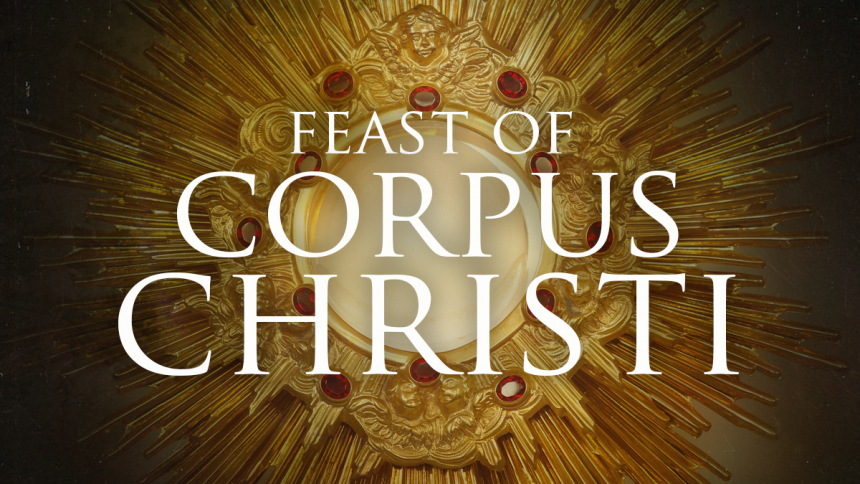
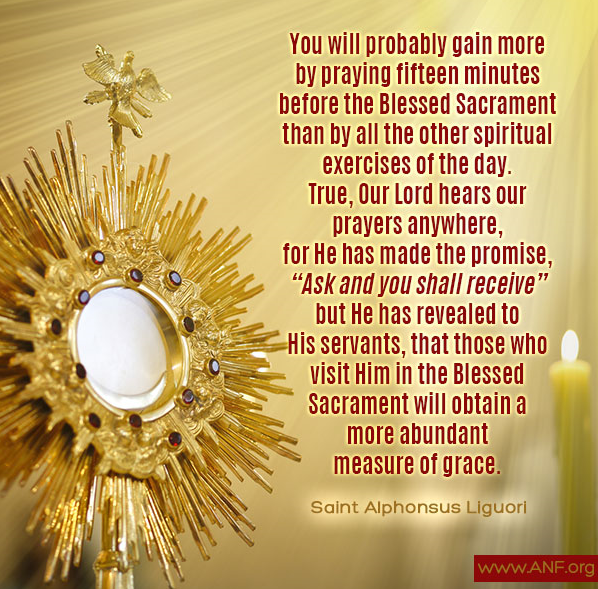
The Solemnity of the Most Holy Body and Blood of Christ, or Corpus Christi, is celebrated on the Thursday after Trinity Sunday in honor of the institution of the Holy Eucharist (in some U.S. dioceses it is transferred to the following Sunday). The feast originated with the visions of St. Juliana of Mont Cornillon, a Belgian nun deeply devoted to the Holy Eucharist, to whom Jesus appeared requesting a feast in honor of the Blessed Sacrament. St. Juliana shared this with the Church hierarchy, and after decades of opposition Pope Urban IV instituted the feast of Corpus Christi for the universal Church in 1264. At the time there was a formal dispute among theologians on the Real Presence of Jesus in the Eucharist—that is, Christ's actual Body, Blood, Soul, and Divinity—for the first time in Church history. In response to this heresy and in support of the authenticity of St. Juliana's visions, a Eucharistic Miracle took place in Orvieto, Italy which proved the truth of the literal interpretation of Christ's doctrine handed down from the Apostles. The Holy Father requested that the liturgy for the feast be composed by St. Thomas Aquinas, now one of the Church's most sublimely poetic liturgies. Corpus Christi is traditionally accompanied with Eucharistic large and elaborate public processions, most notably by the Holy Father in Rome.
†
Quote of the Day "You know well enough that Our Lord does not look so much at the greatness of our actions, nor even at their difficulty, but at the love with which we do them." — St. Therese of Lisieux
Today's Meditation "We live in a fallen world. We must therefore work out our destiny under the conditions created by sin. Did we but realize this truth, we would accept each of life's trying changes in the same spirit in which we accept the penance from the confessor. Were we truly convinced that our hope of pardon, and consequently our salvation, depends upon repentance, we would willingly undergo all the sufferings of life's warfare." —John A. Kane, p. 81
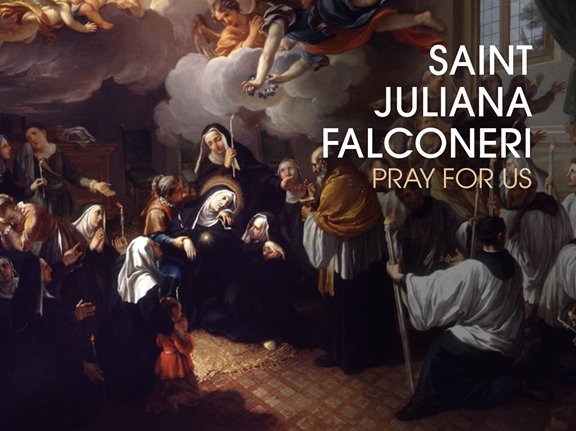
Daily Verse "Beloved, we are God's children now; what we shall be has not yet been revealed. We do know that when it is revealed we shall be like him, for we shall see him as he is." — 1 John 3:2 | Sts Gervase And Protase Juliana Falconieri was born in Florence, Italy in 1270. Her family was wealthy and active in the affairs of the city. When Juliana's father died, her uncle, Alessio Falconieri, helped take care of her. Alessio had dedicated his life to God and was one of the founders of the Servants of Mary (the Servites). His vocation had a profound effect on Juliana and she, too, began to wear the habit and serve the poor. At the young age of sixteen, she became a Servite Tertiary. After her mother died in 1304, Juliana gathered like-minded women, wrote a rule, and founded the Sisters of the Third Order of Servites. Juliana and her sisters offered fasting and many sacrifices in atonement for the violence that was common in Florence during the Middle Ages. Towards the end of her life, Juliana became ill and was unable to eat solid food. Eventually, she was unable to swallow any food. This made it impossible for her to receive the Holy Eucharist. As her death drew near, a priest came to administer Last Rites and give her Viaticum. Juliana asked for a corporal to be spread across her chest and the Blessed Sacrament was placed there, close to her heart. When Juliana died, the Sacred Host disappeared! On Juliana's chest, at the place where the Blessed Sacrament had rested, appeared a cross similar to the one that had been on the host. The Servites continue to include this symbol of the Eucharistic miracle on their religious habit. St Juliana Falconieri died in 1341 and was canonized by Pope Clement XII in 1737. Her feast day is June 19. | 2 Corinthians 11:1-11 Brothers and sisters: If only you would put up with a little foolishness from me! Please put up with me. For I am jealous of you with the jealousy of God, since I betrothed you to one husband to present you as a chaste virgin to Christ. But I am afraid that, as the serpent deceived Eve by his cunning, your thoughts may be corrupted from a sincere and pure commitment to Christ. For if someone comes and preaches another Jesus than the one we preached, or if you receive a different spirit from the one you received or a different gospel from the one you accepted, you put up with it well enough. For I think that I am not in any way inferior to these "superapostles." Even if I am untrained in speaking, I am not so in knowledge; in every way we have made this plain to you in all things. Did I make a mistake when I humbled myself so that you might be exalted, because I preached the Gospel of God to you without charge? I plundered other churches by accepting from them in order to minister to you. And when I was with you and in need, I did not burden anyone, for the brothers who came from Macedonia supplied my needs. So I refrained and will refrain from burdening you in any way. By the truth of Christ in me, this boast of mine shall not be silenced in the regions of Achaia. And why? Because I do not love you? God knows I do! Psalm 111:1-4, 7-8 R. Your works, O Lord, are justice and truth.
or R. Alleluia.
I will give thanks to the Lord with all my heart
in the company and assembly of the just.
Great are the works of the Lord,
exquisite in all their delights. R. Majesty and glory are his work,
and his justice endures forever.
He has won renown for his wondrous deeds;
gracious and merciful is the Lord. R. The works of his hands are faithful and just;
sure are all his precepts,
Reliable forever and ever,
wrought in truth and equity. R. Gospel Acclamation Alleluia, alleluia.
You have received a spirit of adoption as sons
through which we cry: Abba! Father! Rom 8:15bc
Alleluia, alleluia. Matthew 6:7-15 Jesus said to his disciples: "In praying, do not babble like the pagans, who think that they will be heard because of their many words. Do not be like them. Your Father knows what you need before you ask him. "This is how you are to pray: Our Father who art in heaven, hallowed be thy name, thy Kingdom come, thy will be done, on earth as it is in heaven. Give us this day our daily bread; and forgive us our trespasses, as we forgive those who trespass against us; and lead us not into temptation, but deliver us from evil. "If you forgive men their transgressions, your heavenly Father will forgive you. But if you do not forgive men, neither will your Father forgive your transgressions." | Praise to You Oh Lord Jesus Christ! | Our Father . . . (Matthew 6:9) Has there ever been a more powerful or beloved prayer than the Our Father, the prayer that Jesus himself taught us to say? Yet how easy it can be for this prayer to become just another part of our routine! Let's take a little time right now to let the words of St. Augustine help us find new life in a very familiar prayer. "When we pray, Hallowed be thy name, we are counseling ourselves to desire that his name, which is always holy, may be held holy among all people. That is, we are praying that his name would never be treated with disdain or contempt. "When we pray, Thy kingdom come, which will certainly come whether we want it to or not, we can stir our desire for that kingdom. We can ask that it may come for us personally and that, when it comes, we will be worthy to reign with God in his kingdom. "When we pray, Give us this day our daily bread, we mean right now, this present moment. 'Bread' can signify whatever will be sufficient for us to live today. But it can also refer to the sacrament of the Eucharist, which is our spiritual food here and now that helps us obtain everlasting happiness. "When we pray, Forgive us our trespasses as we forgive those who trespass against us, we are advising ourselves both about what we should ask for and what we should do to be worthy to receive it. "When we pray, Lead us not into temptation, we are encouraging ourselves to look to God for his help so that we don't find ourselves left to our own inadequate defenses. How easy it is to give in to temptation through self-deception or self-pity! "Finally, when we pray, Deliver us from evil, we can bring ourselves to reflect on the fact that we are not yet in that blessed condition where we will be free of all evil. This last petition in the Lord's prayer has such a wide scope, in fact, that a Christian in any trouble can use it to help them deal with whatever pains them or causes them tears. We can even pray it first, or at length, or at the end of our intentions." —Adapted from St. Augustine's Letter to Proba. "Heavenly Father, let your kingdom come in my heart today!" 2 Corinthians 11:1-11
Psalm 111:1-4, 7-8 | Reflections with Brother Adrian: |  Hear AI Read it for u | From today's Holy Gospel: "Jesus said to his disciples: "In praying, do not babble like the pagans, who think that they will be heard because of their many words. Do not be like them. Your Father knows what you need before you ask him. "This is how you are to pray: Our Father who art in heaven, hallowed be thy name, thy Kingdom come, thy will be done, on earth as it is in heaven. Give us this day our daily bread; and forgive us our trespasses, as we forgive those who trespass against us; and lead us not into temptation, but deliver us from evil...." end quote. | From Bishop Barron: "Friends, today's Gospel gives us the Our Father. It asks that God's will be done "on earth as it is in heaven," but biblical cosmology sees these two realms as interpenetrating fields of force. Heaven, the arena of God and the angels, touches upon and calls out to earth, the arena of humans, animals, plants, and planets.
Salvation, therefore, is a matter of the meeting of heaven and earth, so that God might reign as thoroughly here below as he does on high. Jesus' great prayer, which is constantly on the lips of Christians, is distinctively Jewish in inspiration: "Thy kingdom come, thy will be done, on earth as it is in heaven."
This is decidedly not a prayer that we might escape from the earth but rather that earth and heaven might come together. The Lord's Prayer raises to a new level what the prophet Isaiah anticipated: "The earth shall be filled with knowledge of the Lord, as water covers the sea."
The first Christians saw the Resurrection of Jesus as the commencement of the process by which earth and heaven were being reconciled. They appreciated the risen Christ as the one who would bring the justice of heaven to this world....." end quote Bishop Barron.
My brothers and my sisters, In Christ, there are no words to describe Corpus Christi. Yes, all the words we've heard, the Holy Scripture, the reflections, all point to Christ, and our Father, but there is no explanation of God, especially of Him in the Holy Eucharist. Nobody should be able to explain God in a nutshell. And that is the problem of today. We want all the answers. We want very little faith. We want everything explained scientifically, quantitatively, and in super simple terms, and if you get it...it is still not enough. You can read the bible, have it explained, but in the end, it still takes a leap of faith to believe. And so it is with the Holy Eucharist, the Body of Christ formed on the altar, by the hands of the authorized priest of the Catholic Church. I believe He is here, and yes, He is everywhere, but not like in the Eucharist, where He is Body, Blood, and Soul. You see, the mystery of God, is the mystery of Love. The mystery of total self giving does not make sense to us in the world. It makes total sense in Heaven, but for us, we cannot trust very many, and for good reason; because we live in the world! But the law is very clear, the law of God that is. And it is written in the human heart. And so, God is calling upon God, to Himself, like a net cast across the world, collecting Himself with treasures of His love. This is a net we do indeed want to be caught up in, higher and higher into the realms of Heaven. This metaphysical, quantum entanglement is beyond comprehension. Our Lord has painted Himself in rocks in Columbia, and lately in the Eucharist in India, and has metaphysically entered Himself in Eucharistic miracles through the ages, even to me personally twice, seeing with my own eyes the flesh of Christ on the altar. And I show up to receive Him daily if and when at all possible because....I KNOW.
There is an ex-witch wizard and satanist named Zachary that was converted, and almost immediately he started going to adoration, to visit our Lord in the Holy Eucharist. His testimony said he was astounded that there is virtually nobody at adorations. What gets him though, is that He says He sees the Lord at the Eucharist. So this makes it more disturbing inside, much like what I feel like when I see very few people in daily Mass. If only people knew the hidden realities! If only we would believe!
The Eucharist is our Lord's Body, Blood, Soul, and Divinity. His body unites with ours in an intimate setting that was set up before the beginning of time.
And He comes daily, in the bread, to make us Holy, to do God's will, who is Our Father, who is in Heaven. That we may love like God, Jesus, in mercy, and to be strengthened as we live in the world.
Sweet Sacrament, we Thee Adore! Oh Make us Love Thee more and more!
Give us this love to love Thee in return! |  audio | Random Bible Verse 1
Romans 6:3–4 3 Do you not know that all of us who have been baptized into Christ Jesus were baptized into his death? 4 We were buried therefore with him by baptism into death, in order that, just as Christ was raised from the dead by the glory of the Father, we too might walk in newness of life. | If one day you don't receive these, just visit Going4th.com
God Bless You! Peace | | |