†
Quote of the Day "Commitment is doing what you said you would do, after the feeling you said it in has passed." — St. Camillus
Today's Meditation "Although our Divine Redeemer was the Lord and Master of all the riches of Heaven and earth, He willed nevertheless to become poor in this world that through His example we might become rich. He wished to induce us to love poverty as He did, for poverty, by detaching us from earthly riches, enables us to share in the treasures of Heaven. ... [It is] the teaching of our Blessed Lord that the poor in spirit shall have a great and certain reward. Their reward is certain, for when our Savior enumerated the Beatitudes in the Gospel, He referred in most instances to the future ... but to the poor in spirit, He promises happiness even in this life: 'Blessed are the poor in spirit for theirs is the kingdom of heaven.' (Matt. 5:3). While here on earth, they receive special graces. The reward of the poor in spirit is, secondly, very great. 'The less we have here,' says St. Teresa, 'the greater will be our joy in Heaven, where our dwelling shall correspond to the love with which we imitated the life of poverty of our Divine Master here on earth'. The truly poor in spirit enjoy a heavenly peace even here in this world. ... [He] who is poor from choice despises the possessions of this earth and is at the same time the master of all." —St. Alphonsus Liguori, p. 122
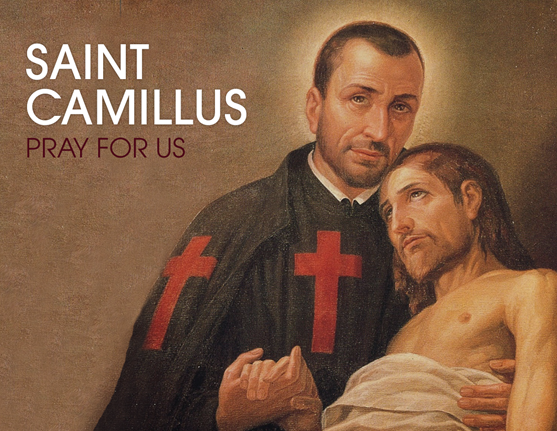
Daily Verse "Be strong and of good courage, do not fear or be in dread of them: for it is the Lord your God who goes with you; he will not fail you or forsake you." — Deuteronomy 31:6 | St. Camillus de Lellis (1550–1614) was a wild, undisciplined youth who became a battle-hardened soldier with a violent temper and a gambling addiction. His bad behavior, combined with a persistent war wound in his leg, left him in poverty. He found work doing odd jobs at a Capuchin friary. Gradually the good influence of the friars inspired him to a better life, and he experienced a true conversion. He sought to join the Franciscans, but was prevented due to his leg wound. He then moved to Rome and worked for a hospital that cared for patients with incurable illnesses. He later became its director as he continued a life of penance and virtue. Seeing that his patients often received poor attention from hospital staff, he devoted his life to providing excellent care for the sick, in whom he saw the face of Christ. He established a religious order of men committed to helping patients who were the most ill, even at the risk of their own well-being, known as the Order of St. Camillus, or the Camillians. For this task he studied for the priesthood and was ordained at the late age of 34. His order gave medical care to anyone in need of treatment. In addition to serving in hospitals, they also served on the battlefield. The Camillians developed into a worldwide relief effort of like-minded medical workers who seek to follow Christ through ministering to the sick. The large red cross on his habit became an international symbol of charitable medical aid. St. Camillus is the patron of the sick, hospitals, nurses, and physicians. His feast day is July 18th. | Friday of the Fifteenth Week in Ordinary Time Reading 1 Exodus 11:10—12:14 Although Moses and Aaron performed various wonders
in Pharaoh's presence,
the LORD made Pharaoh obstinate,
and he would not let the children of Israel leave his land. The LORD said to Moses and Aaron in the land of Egypt,
"This month shall stand at the head of your calendar;
you shall reckon it the first month of the year.
Tell the whole community of Israel: On the tenth of this month
every one of your families must procure for itself a lamb,
one apiece for each household.
If a family is too small for a whole lamb,
it shall join the nearest household in procuring one
and shall share in the lamb
in proportion to the number of persons who partake of it.
The lamb must be a year-old male and without blemish.
You may take it from either the sheep or the goats.
You shall keep it until the fourteenth day of this month, and then,
with the whole assembly of Israel present,
it shall be slaughtered during the evening twilight.
They shall take some of its blood
and apply it to the two doorposts and the lintel
of every house in which they partake of the lamb.
That same night they shall eat its roasted flesh
with unleavened bread and bitter herbs.
It shall not be eaten raw or boiled, but roasted whole,
with its head and shanks and inner organs.
None of it must be kept beyond the next morning;
whatever is left over in the morning shall be burned up. "This is how you are to eat it:
with your loins girt, sandals on your feet and your staff in hand,
you shall eat like those who are in flight.
It is the Passover of the LORD.
For on this same night I will go through Egypt,
striking down every first born of the land, both man and beast,
and executing judgment on all the gods of Egypt—I, the LORD!
But the blood will mark the houses where you are.
Seeing the blood, I will pass over you;
thus, when I strike the land of Egypt,
no destructive blow will come upon you. "This day shall be a memorial feast for you,
which all your generations shall celebrate
with pilgrimage to the LORD, as a perpetual institution." Responsorial Psalm Psalm 116:12-13, 15 and 16bc, 17-18 R. (13) I will take the cup of salvation, and call on the name of the Lord.
How shall I make a return to the LORD
for all the good he has done for me?
The cup of salvation I will take up,
and I will call upon the name of the LORD. R. I will take the cup of salvation, and call on the name of the Lord.
Precious in the eyes of the LORD
is the death of his faithful ones.
I am your servant, the son of your handmaid;
you have loosed my bonds. R. I will take the cup of salvation, and call on the name of the Lord.
To you will I offer sacrifice of thanksgiving,
and I will call upon the name of the LORD.
My vows to the LORD I will pay
in the presence of all his people. R. I will take the cup of salvation, and call on the name of the Lord. Alleluia John 10:27
R. Alleluia, alleluia.
My sheep hear my voice, says the Lord,
I know them, and they follow me.
R. Alleluia, alleluia. Gospel Matthew 12:1-8 Jesus was going through a field of grain on the sabbath.
His disciples were hungry
and began to pick the heads of grain and eat them.
When the Pharisees saw this, they said to him,
"See, your disciples are doing what is unlawful to do on the sabbath."
He said to them, "Have you not read what David did
when he and his companions were hungry,
how he went into the house of God and ate the bread of offering,
which neither he nor his companions
but only the priests could lawfully eat?
Or have you not read in the law that on the sabbath
the priests serving in the temple violate the sabbath
and are innocent?
I say to you, something greater than the temple is here.
If you knew what this meant, I desire mercy, not sacrifice,
you would not have condemned these innocent men.
For the Son of Man is Lord of the sabbath." | Praise to You Oh Lord Jesus Christ! | Daily Meditation: Matthew 12:1-8 I desire mercy, not sacrifice. (Matthew 12:7) Why was Jesus so hard on the Pharisees? Weren't they trying their best to keep the laws that had been handed down to them? God's commandment, given to Moses, was to "remember the sabbath day—keep it holy" (Exodus 20:8). But in the centuries that followed, various scribes interpreted this commandment as prohibiting at least thirty-nine types of "work," including harvesting. So when the Pharisees in today's Gospel questioned Jesus about his disciples picking grain on the Sabbath, they were standing on the solid ground of tradition. Rules matter; they give us a framework in which to thrive. But Jesus always challenged his listeners—and he challenges us—to beware of monitoring how well we think other people are following rules. For example, we may hold deeply to the Sunday obligation to attend Mass. We may also "refrain from engaging in work or activities that hinder the worship owed to God" (Catechism, 2185) and take care to "avoid making unnecessary demands on others" (2187). This is good! But do we then look around at how others are celebrating—or not celebrating—the Lord's Day? Do we get frustrated when our adult children don't honor it as we do, or when a fellow parishioner doesn't seem to see the importance of this day? If God has given you the faith and the freedom to honor the Sabbath so diligently, rejoice! Thank him for this grace! At the same time, Jesus, "Lord of the sabbath" (Matthew 12:8), invites you to "desire mercy, not sacrifice" (12:7) as you consider how others are following him. Try to avoid scrutinizing their actions and motives too closely. Today's Gospel reading makes it clear that while God's commandments, rules, and traditions are central to living out our faith, they should help us to look at God with gratitude while also viewing our neighbor with grace and without judgment. Today, thank the Lord for the gifts he has given you: faith, forgiveness, joy, and the grace to do his will. At the same time, pray for the ability to love other people with the same mercy that God has shown to you. "Lord, thank you for shaping my heart to see others with mercy." Exodus 11:10–12:14
Psalm 116:12-13, 15-18 | Reflections with Brother Adrian: |  Hear AI Read it for u | From today's Holy Gospel: "Or have you not read in the law that on the sabbath
the priests serving in the temple violate the sabbath
and are innocent?
I say to you, something greater than the temple is here.
If you knew what this meant, I desire mercy, not sacrifice,
you would not have condemned these innocent men.
For the Son of Man is Lord of the sabbath." | From Bishop Barron today:
"Friends, in today's Gospel, Jesus corrects the Pharisees with this theme of his ministry: "I desire mercy, not sacrifice." Every saint had a past, and every sinner has a future. That is key to Catholic spirituality. In the lives of every one of these heroes of the faith, there is some conversion. And every sinner—every one of us—has a future. That is why we soak in the mercy of God. There is a beautiful reference in the Psalms to oil running down upon your beard, upon the collar of your robe. The divine mercy is like that: poured out upon us, poured out without reservation—and not because it's earned, because it can't be earned. God doesn't love us because we're worthy. We're worthy because he loves us. We don't deserve his mercy, but we soak it in and thereby are transformed." end quote.
Those words haunt me from our Lord, and they should haunt everybody: I DESIRE MERCY, not sacriice".
The other day, I was feeling like my feelings got hurt by someone. As I pondered how cruel they treat me, I began to take a 3rd party look at the ordeal. That person hurting my feelings will be held liable for that, for doing me wrong, right? BUT, wait just a minute! You can stop them from being held liable, I can stop that judgement on them, can't we?
I said to myself " I do not desire their condemnation...but salvation" and immediately, the hurt feelings went away, and something strange happened in my heart, the hurt went away, and I was happy...like a little kid that forgot and went right back to playing and loving.
Can we all love like that, always? Immediately forgiving or not being hurt at all in the first place? Let's say someone said something cruel, or totally forgot about you! Ouch! Right? It happens, and for some, it might happen more often than not.
This is where the life and grace of our Lord Jesus must come in.
All those back stabbings...on our Lord. What did He feel? His very followers abandoned Him as He hung on the cross, scared and cared only for their own lives! All except Mother Mary and another lady and a follower, right? Rejected, and alone. I think of the song "Above All" that I sing at the nursing home...and that line always strikes a chord when I sing to them as if they feel the words "rejected...and alone". They live alone, often forgotten, just like the prisoners. But not all have forgotten them, I go, some of my kids go, and my wife, we go lift their spirits, and at the same time...our lives change.
Something happens when you abandon yourself. Love then...is mercy.
God is Jesus.
And we are called to be the Body Of Our Lord on earth.. as it IS in Heaven. |  audio | Random Bible Verse 1
Proverbs 16:28 28 A dishonest man spreads strife, and a whisperer separates close friends. | If one day you don't receive these, just visit Going4th.com
God Bless You! Peace | | |