Quote: "Patience smooths away lots of difficulties." -St. John Bosco Today's Meditation "Throughout Sacred Scripture, we find that when God's people fast, the power of their prayers is increased, especially when they are engaged in spiritual warfare. In the Old Testament, the Lord told Isaiah that a fast properly undertaken would 'loose the bonds of wickedness ... undo the thongs of the yoke ... let the oppressed go free' (Is. 58:6) ... In the New Testament, we find that Jesus fasted for forty days and nights in the wilderness in preparation for His battle with Satan, who came to tempt Him (see Lk 4:1-2) ... If prayer is a spiritual weapon, fasting is the spiritual whetstone on which it is sharpened. It's the spiritual muscle that, when exercised regularly, strengthens the thrust of that weapon to pierce the Enemy and drive him away." —Paul Thigpen, p. 42
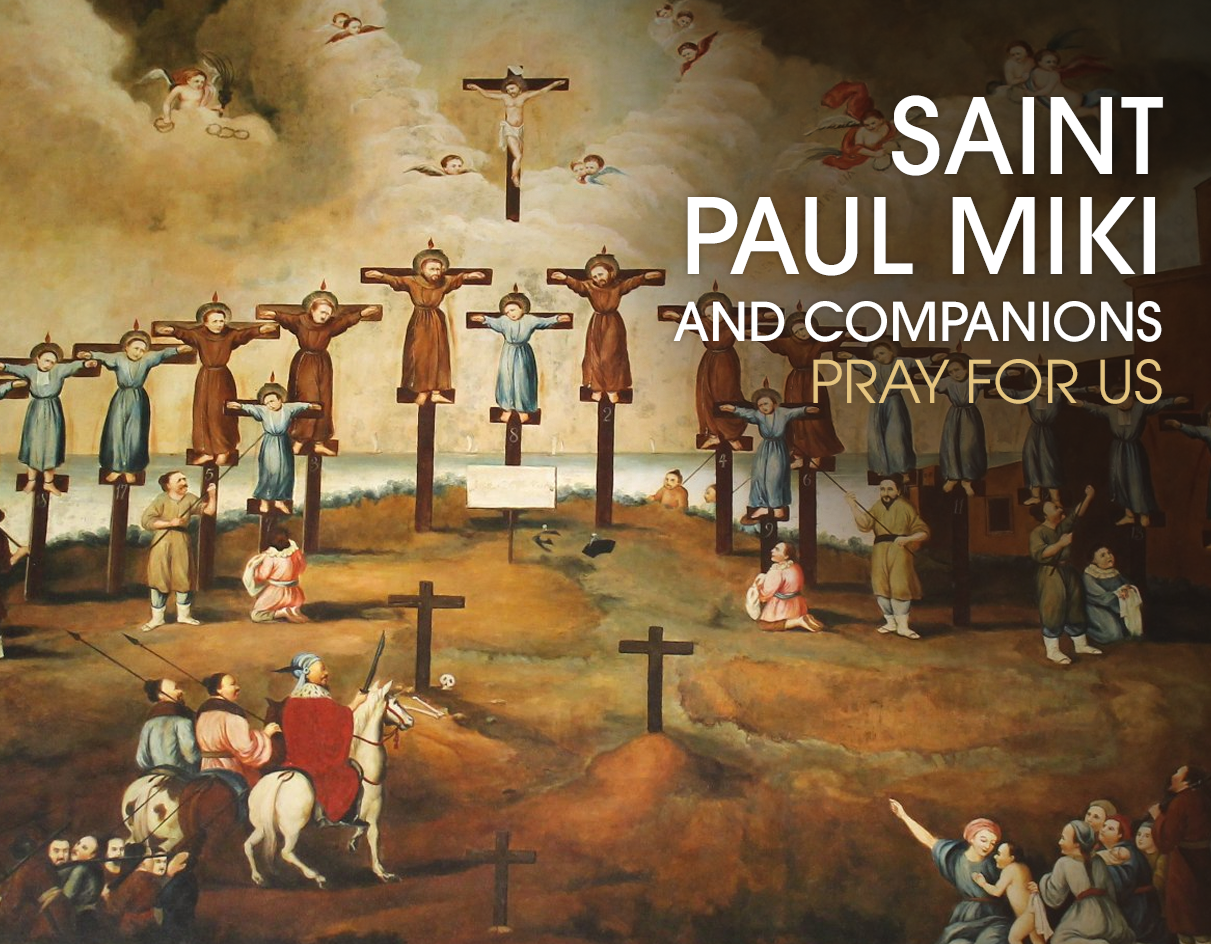
An excerpt from Manual for Spiritual Warfare Daily Verse "My children, I am writing this to you so that you may not commit sin. But if anyone does sin, we have an Advocate with the Father, Jesus Christ the righteous one. He is expiation for our sins, and not for our sins only but for those of the whole world." -1 John 2:1-2 |  EWTN Daily Saint | | Saint Paul Miki And Companions St. Paul Miki (1562–1597) and his twenty-five companions, known as the Martyrs of Nagasaki, were crucified for the faith in Nagasaki, Japan, in 1597. A Japanese layman of great nobility and wealth, Paul was converted to Christianity by St. Francis Xavier. Although the Christian missionaries did not meet with opposition initially, the Japanese rulers eventually launched a brutal campaign to wipe out its progress. The twenty-six men were forced to march 600 miles to meet their death in Nagasaki. The group included Franciscan and Jesuit missionaries and Japanese converts. They were repeatedly offered freedom if they would renounce Christianity; they all declined. When the march ended the martyrs were tied to crosses. They prayed and sang while Paul Miki preached the Gospel in a loud voice. The martyrs were then stabbed to death while they hung on their crosses. The crowd who witnessed the testimony of Paul Miki and his companions would immortalize his words and use them to further spread Christianity in Japan. Their collective feast day is February 6th. | Memorial of Saint Paul Miki and Companions, Martyrs Lectionary: 327 Reading I Sirach 47:2-11 Like the choice fat of the sacred offerings, so was David in Israel.
He made sport of lions as though they were kids, and of bears, like lambs of the flock.
As a youth he slew the giant and wiped out the people's disgrace,
When his hand let fly the slingstone that crushed the pride of Goliath.
Since he called upon the Most High God, who gave strength to his right arm
To defeat the skilled warrior and raise up the might of his people,
Therefore the women sang his praises, and ascribed to him tens of thousands and praised him when they blessed the Lord.
When he assumed the royal crown, he battled and subdued the enemy on every side.
He destroyed the hostile Philistines and shattered their power till our own day.
With his every deed he offered thanks to God Most High, in words of praise.
With his whole being he loved his Maker and daily had his praises sung; He set singers before the altar and by their voices he made sweet melodies,
He added beauty to the feasts and solemnized the seasons of each year
So that when the Holy Name was praised, before daybreak the sanctuary would resound.
The Lord forgave him his sins and exalted his strength forever;
He conferred on him the rights of royalty and established his throne in Israel. Responsorial Psalm Psalm 18:31, 47 and 50, 51 R. (see 47b) Blessed be God my salvation!
God's way is unerring, the promise of the LORD is fire-tried; he is a shield to all who take refuge in him.
R. Blessed be God my salvation!
The LORD live! And blessed be my Rock! Extolled be God my savior.
Therefore will I proclaim you, O LORD, among the nations, and I will sing praise to your name.
R. Blessed be God my salvation!
You who gave great victories to your king and showed kindness to your anointed, to David and his posterity forever.
R. Blessed be God my salvation! Alleluia See Luke 8:15 R. Alleluia, alleluia.
Blessed are they who have kept the word with a generous heart,
and yield a harvest through perseverance.
R. Alleluia, alleluia. Gospel Mark 6:14-29 King Herod heard about Jesus, for his fame had become widespread,
and people were saying,
"John the Baptist has been raised from the dead;
that is why mighty powers are at work in him."
Others were saying, "He is Elijah";
still others, "He is a prophet like any of the prophets."
But when Herod learned of it, he said,
"It is John whom I beheaded. He has been raised up." Herod was the one who had John arrested and bound in prison
on account of Herodias,
the wife of his brother Philip, whom he had married.
John had said to Herod,
"It is not lawful for you to have your brother's wife."
Herodias harbored a grudge against him
and wanted to kill him but was unable to do so.
Herod feared John, knowing him to be a righteous and holy man,
and kept him in custody.
When he heard him speak he was very much perplexed,
yet he liked to listen to him.
Herodias had an opportunity one day when Herod, on his birthday,
gave a banquet for his courtiers, his military officers,
and the leading men of Galilee.
His own daughter came in and performed a dance
that delighted Herod and his guests.
The king said to the girl,
"Ask of me whatever you wish and I will grant it to you."
He even swore many things to her,
"I will grant you whatever you ask of me,
even to half of my kingdom."
She went out and said to her mother,
"What shall I ask for?"
Her mother replied, "The head of John the Baptist."
The girl hurried back to the king's presence and made her request,
"I want you to give me at once on a platter
the head of John the Baptist."
The king was deeply distressed,
but because of his oaths and the guests
he did not wish to break his word to her.
So he promptly dispatched an executioner
with orders to bring back his head.
He went off and beheaded him in the prison.
He brought in the head on a platter
and gave it to the girl.
The girl in turn gave it to her mother.
When his disciples heard about it,
they came and took his body and laid it in a tomb. | Praise to You Oh Lord Jesus Christ! |  click to see website | |  wau.org | Daily Meditation: Sirach 47:2-11 He offered thanks to God Most High, in words of praise. (Sirach 47:8) The Book of Sirach dedicates some of its final chapters to the praise of Israel's ancestors—and in today's first reading, Sirach describes King David. We know that David is one of the greatest heroes of Israel, so it makes sense for these verses to praise him for his courageous and magnificent deeds. But our reading from Sirach also praises David's heart of worship and the joy he found in his relationship with the Lord. Sirach tells us that because God showed him great mercy and love, David "offered thanks to God Most High, in words of praise" (47:8). Sirach knew that many of the psalms we find in the Scriptures are attributed to David, and that they are all testimonies to David's joy and openness to the Lord. Even in his psalms of lament and repentance, David couldn't help but find ways to give thanks and praise to the Lord (see, for instance, Psalm 13). In all the circumstances of his life, David poured out his heart to God in prayer. So what can we learn from David's example? The value and blessing of prayer! The psalms constantly portray David as praising the Lord for his wonders and for the blessings he had poured out in his life. Even in one of his lowest points, when God used the prophet Nathan to confront David over his sins, David quickly repented and turned to the Lord for mercy (see 2 Samuel 12:13; Psalm 51). In the same way that the people of Israel used the psalms in both personal and liturgical prayer, we can use them in our daily prayer. When we turn away from God and need to ask for his mercy, prayers like Psalms 6 and 51 can help us to acknowledge our sin and offer us words to express our repentance to the Lord. And when we want to thank God and praise him for all his blessings, we can pray today's psalm, for example, or any number of others that will inspire us to extol our faithful Lord. So let the psalms inspire you with words of praise and thanksgiving. Let them fill your heart with the same joy that King David had. Today, you can join him and sing: "Extolled be God my savior! (Psalm 18:47)" Psalm 18:31, 47, 50-51
Mark 6:17-19 | Reflections with Brother Adrian: |  Audio of 2 Cents | From today's Holy Gospel: "... Herod was the one who had John arrested and bound in prison
on account of Herodias,
the wife of his brother Philip, whom he had married.
John had said to Herod,
"It is not lawful for you to have your brother's wife."
Herodias harbored a grudge against him
and wanted to kill him but was unable to do so.
Herod feared John, knowing him to be a righteous and holy man,
and kept him in custody.
When he heard him speak he was very much perplexed,
yet he liked to listen to him. ....." Word of the Lord.
| Roberto Juarez Reflection with Ai fine tune: "The Gospel reading recounts the death of John the Baptist, a stark and pivotal story that illuminates the fate of prophets and foreshadows Jesus' own path.
Herod, troubled by reports of Jesus, fears that John—whom he beheaded—has risen from the dead. This reveals a deep truth: even when truth is violently silenced, it continues to echo in the conscience. John dies because of his unwavering fidelity to his mission. He did not seek conflict but refused to stay silent in the face of grave injustice (Herod's immoral union). He denounced it courageously, knowing the risk, showing himself as a free, coherent prophet who stood firm against power.
The contrast with Herod is striking: John: lives in austerity, truth, and fidelity to God.
Herod: trapped by fear, weakness, and social pressure. He recognizes John's holiness but lacks the courage to follow his conscience, choosing instead to please others and preserve appearances. The passage challenges us personally: When forced to choose, do we heed the voice of conscience or the clamor of the crowd? Truth or comfort? Often, we avoid evil not from conviction but from weakness, fear of judgment, or desire to maintain equilibrium. John's martyrdom reminds us that fidelity to the Gospel has a cost—it may not be popular or understood, and it can mean swimming against the current. Yet this is the path to authentic freedom. The story also prefigures Jesus: John, as the forerunner, anticipates rejection, suffering, and the cross. The Gospel promises not an easy life, but a genuine one. Today, John invites us to examine our Christian consistency—not through grand heroic acts, but through everyday fidelity: speaking truth with charity, living with integrity, and refusing to trade conscience for convenience. Let us pray for a free and courageous heart that listens to God's voice and remains faithful even in difficulty. May John's witness inspire us to live an undivided, wholehearted faith."
From Bishop Barron: "In the early twenty-first century, martyrdom remains a stunningly common fact of Christian life. One high-end estimate for the number of Christian martyrs killed each year is one hundred thousand, while the low end is around eight thousand—ranging from one new martyr every five minutes to one every hour. The example of the martyrs draws people to wonder what it is that would induce so many to make the ultimate sacrifice. The Church Father Tertullian said that "the blood of the martyrs is the seed of the Church," and it's a rare case of a theological maxim for which there's actually empirical confirmation.
From Adrian: Saint John the Baptist was leading the way. In Matthew 11:11 and Luke 7:28, Jesus declares that "among those born of women there has not arisen anyone greater than John the Baptist". This signifies that John is the greatest prophet because he directly introduced the Messiah, marking the culmination of the Old Testament prophet
John fasted.
John proclaimed the Kingdom coming.
John baptized, leading heart to prepare for the coming of God.
John gave his life, for purity, and the message of God.
And we are to do the same.
Soon, we will be asked to fast. Yet, Holy Church asks us to fast every friday, or abstain from something. Fasting gives power to prayer.
In Catholic tradition,
all Fridays of the year are designated as days of penance to honor Christ's crucifixion. While mandatory abstinence from meat is strictly required only on Fridays during Lent, Canon Law encourages voluntary, year-round abstinence or alternative acts of penance (charity, fasting) on all other Fridays. In Catholic theology, fasting is a powerful, voluntarily chosen spiritual discipline that strengthens one's relationship with God by fostering humility, self-control, and penance. It is viewed not merely as dieting, but as a way to mortify the flesh, atone for sin, enhance prayer, and stand in solidarity with the poor. Perpetuity of fasting then can lead to a powerful life with God.
Why? It becomes something more than you. It becomes something about depending and trusting in God. It become something about sacrifice. In my world, if I fast, a praise better, I pray better, I am hungry, and vulnerable, more weak. But in this weakness, we are made strong, this holy unification with God our Father.
I invite you to fast or abstain on Fridays, ALWAYS. And to pray the 3pm Divine Mercy chaplet daily.
This is a unification and reunification with God our Father in Jesus. A uniting bond of love and sacrifice, for us, and the whole world.
Holy Martyrs...pray for us! |  Click for Audio | Random Bible Verse 1
Matthew 28:18–20 'And Jesus came and said to them, "All authority in heaven and on earth has been given to me. 19 Go therefore and make disciples of all nations, baptizing them in1 the name of the Father and of the Son and of the Holy Spirit, 20 teaching them to observe all that I have commanded you. And behold, I am with you always, to the end of the age." . . . Word of the Lord! |  Going4th.com | If one day you don't receive these, just visit Going4th.com
God Bless You! Peace | | |