†Cheerfulness prepares a glorious mind for all the noblest acts. ▪ St. Elizabeth Ann Seton
| ▪ |
St. Elizabeth Ann Seton |
“Consider not only that God your benefactor is present but also that He acts continuously in all His creatures. And for whom is this continual action, this work of God in nature? For you. Thus, He lights you by the light of day; He nourishes you with the productions of the earth; in a word, He serves you by each one of the creatures that you use; so that it is true to say that at every moment the bounty, the wisdom and the power of God are at your service and are exercised in the world for your wants or pleasures. This conduct of God toward man should be the model of your conduct toward God. You see that the presence of God in His creatures is never idle; it acts incessantly, it preserves, it governs. Beware, then, of stopping at a sterile contemplation of God present in yourself. Add action to contemplation; to the sight of the Divine presence add the faithful accomplishment of the Divine will.” —St. Ignatius, p. 182
Daily Verse †Love is patient, love is kind. It is not jealous, [love] is not pompous, it is not inflated, it is not rude, it does not seek its own interests, it is not quick-tempered, it does not brood over injury, it does not rejoice over wrongdoing but rejoices with the truth. It bears all things, believes all things, hopes all things, endures all things. Love never fails. If there are prophecies, they will be brought to nothing; if tongues, they will cease; if knowledge, it will be brought to nothing. ▪ 1 Corinthians 13:4-8
|

EWTN Daily Saint
|
|
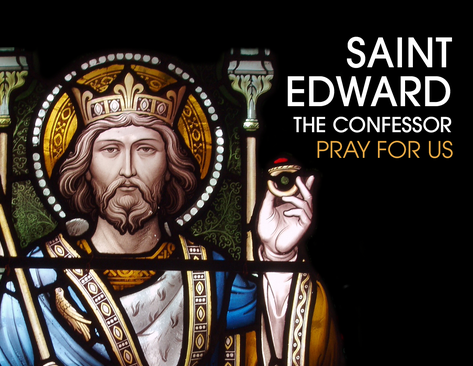
St. Edward the ConfessorPatron Saint of: England, kings, and difficult marriages
Feast Day: October 13 St. Edward the Confessor (1003-1066 A.D.) was a prince born to the King and Queen of England. His family was exiled from the kingdom when the Danish took control of the country in 1016 A.D. Edward spent much of his life in exile, probably in Normandy. Witnessing the folly of worldly ambition, he became attracted to the life of the Church and grew in piety. When opportunity arose he was persuaded to reclaim the throne of England, which he did in 1042 as one of its last Anglo-Saxon kings. The people supported his rule, and he gained a reputation as a just king committed to the welfare of his subjects. He thwarted invasions, ended unjust taxes, and was profoundly generous to the poor. His reign was marked by peace and prosperity throughout his kingdom. He married a beautiful woman to satisfy the people’s desire for a queen, but, having already made a vow of chastity, he obtained his wife’s agreement to live together as brother and sister. He was buried in Westminster Abbey, which he built, and after his death many miracles were ascribed to his intercession. This lead to his canonization in 1161, and in 1163 the transferral of his body to a new tomb. This was presided over by St. Thomas Becket, the Archbishop of Canterbury, who found Edward’s body to be incorrupt. Edward was called “The Confessor” to distinguish him from St. Edward the Martyr. He is buried behind the high altar in Westminster Abbey. He is the patron of kings, difficult marriages, separated spouses, and the English royal family. His feast day is October 13th.
|
Tuesday of the Twenty-eighth Week in Ordinary TimeLectionary: 468 Reading 1Galatians 5:1-6 Brothers and sisters:
For freedom Christ set us free;
so stand firm and do not submit again to the yoke of slavery. It is I, Paul, who am telling you
that if you have yourselves circumcised,
Christ will be of no benefit to you.
Once again I declare to every man who has himself circumcised
that he is bound to observe the entire law.
You are separated from Christ,
you who are trying to be justified by law;
you have fallen from grace.
For through the Spirit, by faith, we await the hope of righteousness.
For in Christ Jesus,
neither circumcision nor uncircumcision counts for anything,
but only faith working through love. Responsorial PsalmPsalm 119:41, 43, 44, 45, 47, 48 R. (41a) Let your mercy come to me, O Lord.
Let your mercy come to me, O LORD,
your salvation according to your promise.
R. Let your mercy come to me, O Lord.
Take not the word of truth from my mouth,
for in your ordinances is my hope.
R. Let your mercy come to me, O Lord.
And I will keep your law continually,
forever and ever.
R. Let your mercy come to me, O Lord.
And I will walk at liberty,
because I seek your precepts.
R. Let your mercy come to me, O Lord.
And I will delight in your commands,
which I love.
R. Let your mercy come to me, O Lord.
And I will lift up my hands to your commands
and meditate on your statutes.
R. Let your mercy come to me, O Lord. AlleluiaHebrews 4:12 R. Alleluia, alleluia.
The word of God is living and effective,
able to discern reflections and thoughts of the heart.
R. Alleluia, alleluia. GospelLuke 11:37-41 After Jesus had spoken,
a Pharisee invited him to dine at his home.
He entered and reclined at table to eat.
The Pharisee was amazed to see
that he did not observe the prescribed washing before the meal.
The Lord said to him, “Oh you Pharisees!
Although you cleanse the outside of the cup and the dish,
inside you are filled with plunder and evil.
You fools!
Did not the maker of the outside also make the inside?
But as to what is within, give alms,
and behold, everything will be clean for you.”
|
Praise to You Oh Lord Jesus Christ!
|

From Word Among Us WAU.org
|
Daily Meditation: Psalm 119:41, 43-45, 47-48I will walk at liberty, because I seek your precepts. (Psalm 119:45) Wait a minute! Aren’t “precepts” the opposite of “liberty” (Psalm 119:45)? Doesn’t freedom mean doing whatever you please, whenever you please, regardless of rules and restrictions? Not really. Imagine you run into a stranger who hands you a flute. You seem to like music, he says. Take this flute. Go ahead, and feel free to make music with it! Without instruction, you probably wouldn’t be able to do much with it. But if someone taught you the methods or “precepts” of how to play—where to put your fingers, how to blow into it, how to read music—you would then have the chance to exercise the “freedom” of a musician, especially if you put in the time to practice. You would willingly restrict your freedom to do whatever you want with the flute so that you could learn to play it skillfully. When St. Paul says, “For freedom Christ set us free,” he is talking about that kind of freedom: the freedom to do something beautiful, the liberty to do what pleases the Lord (Galatians 5:1). God didn’t make us free so that we could ignore his commands; he knows they are what guide us to reach our full potential. They are what set us on the path of excellence. Excellence at what? Love of God and love of our neighbors. Jesus delivers us from sin so that we can “walk at liberty” and become like him (Psalm 119:45). We are free to look out for someone else’s needs before our own. We are free to sacrifice on someone else’s behalf. The more this happens, the more like Jesus we become. It will look different for each one of us. A contemplative monk grows in loving in a different way than a young father does. A corporate executive conforms herself to Christ differently than someone living in a nursing home. But for each of us, true freedom comes as we receive the grace to live up to our potential. Remember, loving isn’t accomplished in a single moment or gesture. It happens over time and with practice, just as every rehearsal enables the flute player to play even more beautifully. “Father, thank you for setting me free to live in a way that pleases you!” Galatians 5:1-6
Luke 11:37-41
|
Reflections with Brother Adrian:
|

Click To Hear 2 Cents Audio
|
“The Lord said to him, “Oh you Pharisees!
Although you cleanse the outside of the cup and the dish,
inside you are filled with plunder and evil.
You fools!
Did not the maker of the outside also make the inside?
But as to what is within, give alms,
and behold, everything will be clean for you.”
|
From Roberto Juarez reflections:
"…Jesus concludes with a surprising indication: "Rather give as alms what is inside, and you will have everything clean." The Lord is not saying that it is enough to give money to compensate for any sin. He invites us to understand that true purity is manifested in a generous heart, capable of going out of itself and looking at its neighbor with mercy. Almsgiving, in the biblical tradition, expresses a deeper attitude than the simple giving of goods. It means recognizing that what we have is not only for our enjoyment, but also to serve others. It means sharing without humiliation, helping without seeking applause, and offering the needy a concrete response of love. We can give money, but also time, attention, companionship, listening and understanding. We can visit a sick person, accompany an elderly person, support a family in difficulty, or reach out to those who feel alone. Mercy cleanses the heart because it takes us out of selfishness. It helps us to stop living closed in our interests and teaches us to look at others as brothers and sisters. Here we find a very concrete sign to examine our Christian life: if our relationship with God is authentic, our capacity to love must grow. If we pray more, but become harder; if we know the Gospel better, but are less understanding; if we celebrate the sacraments, but remain indifferent to suffering, we need to review how we are welcoming God's grace. True faith does not distance us from people; it brings us closer to them with the heart of Christ. Today's Gospel reminds us that God is not satisfied with appearances. He desires our hearts, not to dominate us, but to fill it with his love and to make us capable of truly loving. Let us not be afraid to look within. Let us humbly recognize our contradictions and ask the Lord to help us change. May our prayers be translated into patience; our participation in the sacraments, into charity; and our faith, into a more just and generous life. Today let us ask for the grace of an interior cleansing that does not consist in hiding our defects, but in allowing God to enlighten and transform them. May the Lord grant us a renewed heart, free from greed and pride, ready to share and serve. In this way, our whole life will be an offering pleasing to God." end quote.
- - - Bishop Barron ended his reflection on these scriptures today with: "Numerous spiritual masters have witnessed that belief in God is strengthened not so much from intellectual effort as from moral action. When a man asked the English Jesuit poet Gerard Manley Hopkins what he must do in order to believe, Hopkins replied, “Give alms.” As you love through tangible acts, you will come to believe more deeply and to enter more fully into friendship with God." end quote.
- - - This is deep. When our Lord speaks, things get steep in how deep they are. "But as to what is within, give alms,
and behold, everything will be clean for you.”
And this is what caused perhaps, some of the biggest divisions, splits from the church, because alms-giving got spun off in all sorts of directions. But, really, it is a revelation, when we miss the mark, which is at its root word in the Greek language. You see, originally, our Lord spoke of alms-giving, and what it can do to affect your own time in purgatory. Because it is an act of mercy. Giving! It is good! But it got deviated from the intent.
In late-medieval Catholic theology, almsgiving was considered a vital work of mercy that could atone for the temporal punishment of sins. When this concept was fused with purgatory—a post-death state of purification—and the system of indulgences (certificates reducing a soul's time in purgatory), it created a highly commercialized system that the Reformers fiercely rejected.
It seemingly became a sale. Mercy for sale it would seem. Until today, the splits continue to split from each other. Much error. Much confusion now with the faith, and the truth.
Now what?
Now we turn to the Lord, for mercy, Lord forgive us our sins…our many sins. Today, indulgences are rarely spoken about. But we need these indulgences…a gift from God. Artificial intelligence sums it up for us here:
"Making the Sign of the Cross while reciting the customary formula grants a partial indulgence in the Catholic Church. Key Details About the Indulgence • Type of Indulgence: A partial indulgence (which remits temporal punishment due for sins) is attached to the action.
• Required Formula: You must devoutly make the sign on yourself with your right hand while saying: "In the name of the Father, and of the Son, and of the Holy Spirit. Amen."
• Spiritual Application: According to Catholic tradition, partial indulgences can be applied either to oneself or offered as suffrage for the souls in Purgatory.
• Execution: To benefit spiritually, the Church emphasizes that the gesture should be made with attention, reverence, and true devotion rather than a hurried or thoughtless motion " Did you catch that last part? The Lord sees the heart. You must do it properly, and with reverence. God sees the meaning He has applied with the meaning we are applying it to. Back to the Gospel: "You fools!
Did not the maker of the outside also make the inside? " The answer is "YES". Yes He made the inside. And God sees the inside that nobody else sees.
What is inside? Is it empty? Is it full of lies? Is it full of bad spirits? What does He see? The intent…the truth. God values the intent as well. But an intent without fulfillment…an active work to fulfill the intent…counts.
For example, I commit to help at a retreat, that intent is good, but if I am not making meetings for the team, and if I do not show up, the intent was worthless, there was no heart, no sacrifice to fulfill the intent.
Or for those in classes in church, same thing. The heart is what counts!
There are lots of bodies in Church…but they need a heart for God.
And that's where we need to help each other. If you open up your wallet, you open up your heart.
If you open up your heart to God, then He can come in, and shine the light, and dispel the darkness.
Lord help us.
|

Click for Audio
|
Random Bible Verse 1
2 Corinthians 7:10 " For godly grief produces a repentance that leads to salvation without regret, whereas worldly grief produces death."
Word of the Lord!
|
If one day you don't receive these, just visit Going4th.com
God Bless You! Peace
|
|
|





No comments:
Post a Comment