† Quote of the Day“If a tiny spark of God’s love already burns within you, do not expose it to the wind, for it may get blown out… Stay quiet with God. Do not spend your time in useless chatter… Do not give yourself to others so completely that you have nothing left for yourself.” -St. Charles Borromeo Today’s Meditation"[Mary] watched constantly over her own heart ... She watched over her every word as though she could not trust her tongue. In her conception she was given all the privileges that go with sinlessness, yet she decided to live permanently as a penitent! We, on the contrary, are surrounded by flattering, treacherous enemies whose sole aim is to use our natural weaknesses to bring about our fall. Yet we have no fear and are not watchful at all. We admit that we are weakness incarnate, yet frequently we expose ourselves to temptations that would bring down even the strongest soul." —Alexander De Rouville, p. 21
An excerpt from The Imitation of Mary Daily VerseThe Lord is my portion," says my soul, "therefore I will hope in him." The Lord is good to those who wait for him, to the soul that seeks him. It is good that one should wait quietly for the salvation of the Lord. -Lamentations 3: 24-26
Daily Mass Readings
Mass Readings
Homily
|

EWTN Daily Saint
|
|
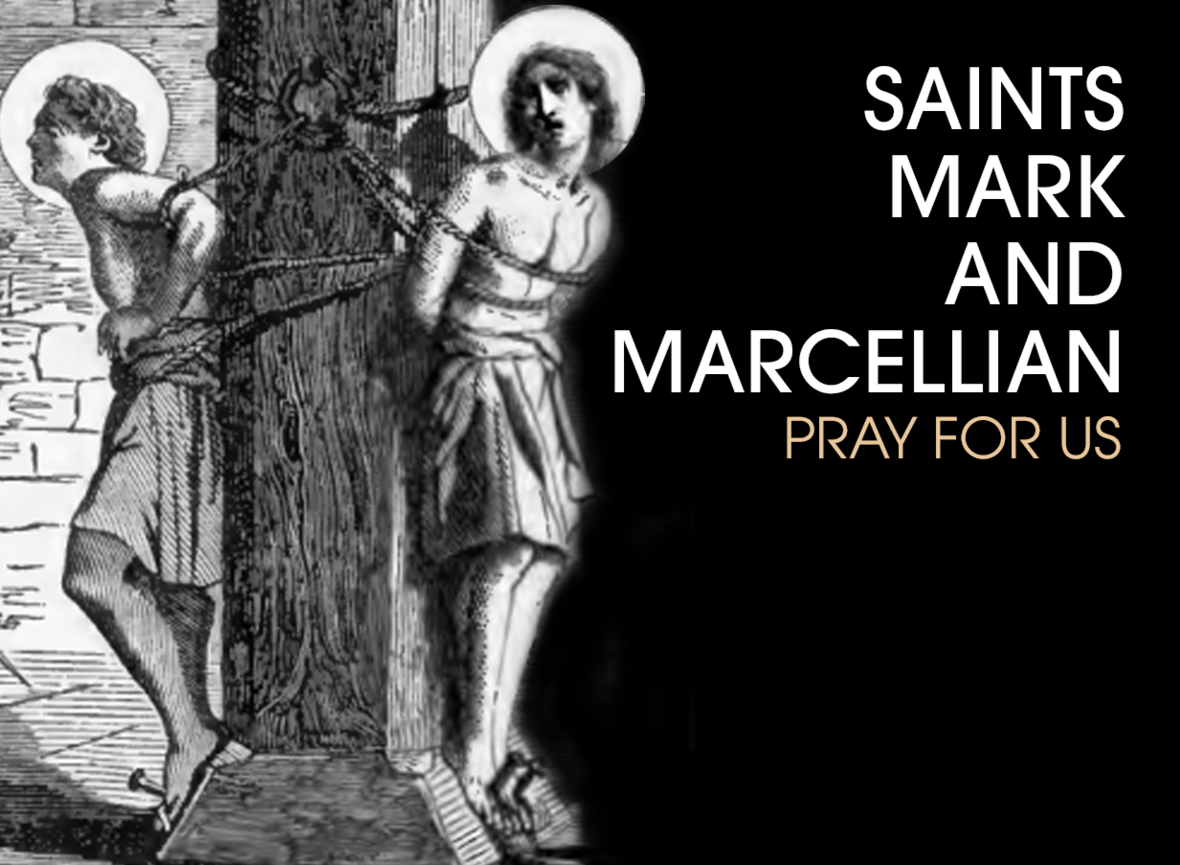
Sts Mark MarcellianSts. Mark and Marcellian (d. 286 A.D.) were twin brothers who were martyred for their faith in Rome under Emperor Diocletian. According to legend they were both deacons from a distinguished family who were thrown into prison for being Christians. Their mother and father, who were pagans, visited their sons in prison and pleaded with them to return to the worship of false gods so that they could be saved. At the same time, St. Sebastian also visited the brothers and encouraged them to stand strong in their faith. St. Sebastian's exhortation was so persuasive that the parents of Marcellian and Mark were converted, along with several friends who were present, as well as the other prisoners. All of these new Christian converts were eventually martyred alongside Mark and Marcellian. The brothers had their feet nailed to a wood post, and later their bodies were pierced with lances. Their feast day is June 18th.
|
Thursday of the Eleventh Week in Ordinary TimeLectionary: 368 Reading 1Sirach 48:1-14 Like a fire there appeared the prophet Elijah
whose words were as a flaming furnace.
Their staff of bread he shattered,
in his zeal he reduced them to straits;
By the Lord’s word he shut up the heavens
and three times brought down fire.
How awesome are you, Elijah, in your wondrous deeds!
Whose glory is equal to yours?
You brought a dead man back to life
from the nether world, by the will of the LORD.
You sent kings down to destruction,
and easily broke their power into pieces.
You brought down nobles, from their beds of sickness.
You heard threats at Sinai,
at Horeb avenging judgments.
You anointed kings who should inflict vengeance,
and a prophet as your successor.
You were taken aloft in a whirlwind of fire,
in a chariot with fiery horses.
You were destined, it is written, in time to come
to put an end to wrath before the day of the LORD,
To turn back the hearts of fathers toward their sons,
and to re-establish the tribes of Jacob.
Blessed is he who shall have seen you
And who falls asleep in your friendship.
For we live only in our life,
but after death our name will not be such.
O Elijah, enveloped in the whirlwind!
Then Elisha, filled with the twofold portion of his spirit,
wrought many marvels by his mere word.
During his lifetime he feared no one,
nor was any man able to intimidate his will.
Nothing was beyond his power;
beneath him flesh was brought back into life.
In life he performed wonders,
and after death, marvelous deeds. Responsorial PsalmPsalm 97:1-2, 3-4, 5-6, 7 R. (12a) Rejoice in the Lord, you just!
The LORD is king; let the earth rejoice;
let the many isles be glad.
Clouds and darkness are round about him,
justice and judgment are the foundation of his throne.
R. Rejoice in the Lord, you just!
Fire goes before him
and consumes his foes round about.
His lightnings illumine the world;
the earth sees and trembles.
R. Rejoice in the Lord, you just!
The mountains melt like wax before the LORD,
before the Lord of all the earth.
The heavens proclaim his justice,
and all peoples see his glory.
R. Rejoice in the Lord, you just!
All who worship graven things are put to shame,
who glory in the things of nought;
all gods are prostrate before him.
R. Rejoice in the Lord, you just! AlleluiaRomans 8:15bc R. Alleluia, alleluia.
You have received a spirit of adoption as sons
through which we cry: Abba! Father!
R. Alleluia, alleluia. GospelMatthew 6:7-15 Jesus said to his disciples:
“In praying, do not babble like the pagans,
who think that they will be heard because of their many words.
Do not be like them.
Your Father knows what you need before you ask him. “This is how you are to pray: ‘Our Father who art in heaven,
hallowed be thy name,
thy Kingdom come,
thy will be done,
on earth as it is in heaven.
Give us this day our daily bread;
and forgive us our trespasses,
as we forgive those who trespass against us;
and lead us not into temptation,
but deliver us from evil.’ “If you forgive others their transgressions,
your heavenly Father will forgive you.
But if you do not forgive others,
neither will your Father forgive your transgressions.”
|
Praise to You Oh Lord Jesus Christ!
|

From Word Among Us WAU.org
|
Daily Meditation: Matthew 6:7-15Our Father who art in heaven. (Matthew 6:9) The crowd listening to Jesus’ Sermon on the Mount has heard him give the Beatitudes and talk about how he fulfills the Law of Moses. But now, he shifts his focus and starts talking about how to pray. And he does so by telling them—and us—to start by calling God “Our Father” (Matthew 6:9). He wants us to know that we have a loving and caring Father who “knows what you need before you ask him” (Matthew 6:8). And so, we can trust him and have a close relationship with him. The Jewish people already knew that God was like a loving Father to them. But their relationship with God was less intimate than in the new covenant that Jesus established. So when he taught about prayer, Jesus offered them a profound new privilege: call God “Our Father.” Call him your Father, Someone you could have a personal relationship with. Speaking in his native Aramaic, he probably used the word Abba, which is a comfortable, familiar way of addressing your father. He was telling them that they could come to God as children confident in their Father’s love for them—individually and personally. We, too, know God as the all-powerful, omnipresent, and eternal Lord of the universe. And he certainly is. However, he is also our Father. Sometimes we can forget that he longs for us to know him also as a Father who loves us, as a Father who wants a personal relationship with us. He knows what we need, and he wants to give us what is best for us. He wants us to sit next to him and tell him everything about what makes us happy or sad, what we think we need, or whatever worries us. And he promises to listen to us as we do. Above all, God wants us to love him. And one way to do that is through prayer. When we pray with the words Jesus taught us in today’s Gospel, we are praising our heavenly Father, accepting his will in our lives, trusting him for what we need, and asking for his mercy and protection. In other words, we are telling him all the ways we love him and are giving our hearts to him. So today, come to your Father and love him. And let him love you! “Jesus, help me to love your Father and to trust in him as my Father.” Sirach 48:1-14
Psalm 97:1-7
|
Reflections with Brother Adrian:
|

Audio of 2 Cents
|
From today's Holy Gospel: ".... Jesus said to his disciples:
“In praying, do not babble like the pagans,
who think that they will be heard because of their many words.
Do not be like them.
Your Father knows what you need before you ask him. “This is how you are to pray: ‘Our Father who art in heaven, ... ”
|
From Bishop Barron: "Friends, today’s Gospel gives us the Our Father. It asks that God’s will be done “on earth as it is in heaven,” but biblical cosmology sees these two realms as interpenetrating fields of force. Heaven, the arena of God and the angels, touches upon and calls out to earth, the arena of humans, animals, plants, and planets. Salvation, therefore, is a matter of the meeting of heaven and earth, so that God might reign as thoroughly here below as he does on high. Jesus’s great prayer, which is constantly on the lips of Christians, is distinctively Jewish in inspiration: “Thy kingdom come, thy will be done, on earth as it is in heaven.” This is decidedly not a prayer that we might escape from the earth, but rather that earth and heaven might come together. The Lord’s Prayer raises to a new level what the prophet Isaiah anticipated: “The earth shall be filled with knowledge of the Lord, as water covers the sea.” The first Christians saw the resurrection of Jesus as the commencement of the process by which earth and heaven were being reconciled. They appreciated the risen Christ as the one who would bring the justice of heaven to this world. " end quote.
From Roberto Juarez:
"We often pray the Lord's Prayer from memory. And that has an advantage: we can do it at any time. But it also has a risk: pronouncing words without thinking about their meaning. Every phrase of the Lord's Prayer is a commitment. When we say, "Thy will be done," we agree to let God lead our lives. "Give us our bread today," we learn to trust. "Forgive us," we recognize that we need mercy. "As we forgive", we accept to become instruments of reconciliation ourselves.
The saints have found in the Lord's Prayer an inexhaustible school. Not because they discovered new meanings. But because they tried to live what they prayed. And perhaps that is the biggest challenge for us. It is not enough to pray the Lord's Prayer. We are called to become a living "Our Father" ourselves. May those who see us discover that we truly believe that God is Father. And that, for that very reason, we treat others as brothers and sisters.
Today Jesus opens the door to his own relationship with the Father. It teaches us that prayer is not a set of formulas, but a trusting encounter with God. Let us ask him never to pray the Lord's Prayer routinely. That every time we speak those words we remember that we are talking to our Father. And may that prayer gradually transform our lives, so that we may learn to trust more, to forgive more, to seek first the Kingdom of God and to live as true children of the Father and brothers and sisters of all."
From bro. Adrian:
A quick search with Catholic and Jewish prayers in context we find:
The Catholic understanding of the Lord's Prayer recognizes it as the ultimate distillation of ancient Jewish prayers. Jesus, as a devout first-century Jew, synthesized the core themes of Jewish piety—praise, petition, and forgiveness—into a single, revolutionary model that reveals the Father and ushers in the Kingdom. [1, 2, 3, 4]
The Lord's Prayer weaves together several major pillars of Jewish liturgical and spiritual tradition: • The Avinu (Our Father): Calling God "Father" reflects the intimate Jewish concept of God as the loving parent of Israel, while the plural "Our" grounds the prayer in a communal identity.
• The Kaddish: "Hallowed be Thy name, Thy Kingdom come" directly echoes the ancient Kaddish prayer ("Magnified and sanctified be His great name in the world..."), expressing a deep longing for God's sovereign rule to be established on earth.
• The Amidah: The petitions for daily needs, forgiveness ("as we forgive our debtors"), and deliverance from temptation correspond to the foundational 18 blessings of the Jewish Amidah prayer.
• The Shema: The submission to God's will ("Thy will be done") mirrors the ultimate Jewish declaration of love and obedience to God found in the Shema. [7] Catholic tradition views the Lord's Prayer not just as one prayer among many, but as the "summary of the whole Gospel." It perfectly balances adoration of God with the practical realities of human fragility and need. It gets deep really quick. Every day, faithful Catholics recite these tremendous prayers that are summed up by our Lord in His prayer. Short, yet, if you know the roots....powerful. If you want to see a quick outline with some more details click here. We pray the same prayers as the first Christians, and all the saints of all time...we are united... with our Lord. But the same persists for us all... how do we pray? It is not only about what we pray, but the disposition, the state of being in our heart.
We can say the name of our Lord, but it is not going to be efficacious if it is said without meaning, and I mean here....faith.
It is the same with all things. The Rosary.
God hears with the heart.
And the prayer is a heart to heart connection. Let those who have ears to Him listen now....
|
Click to hear
|
Random Bible Verse Psalm 103:2–5 [Psalm 103] 2 Bless the LORD, O my soul, and forget not all his benefits,
3 who forgives all your iniquity, who heals all your diseases,
4 who redeems your life from the pit, who crowns you with steadfast love and mercy,
5 who satisfies you with good so that your youth is renewed like the eagle’s.
Word of the Lord!
|
If one day you don't receive these, just visit Going4th.com
God Bless You! Peace
|
|
|




No comments:
Post a Comment