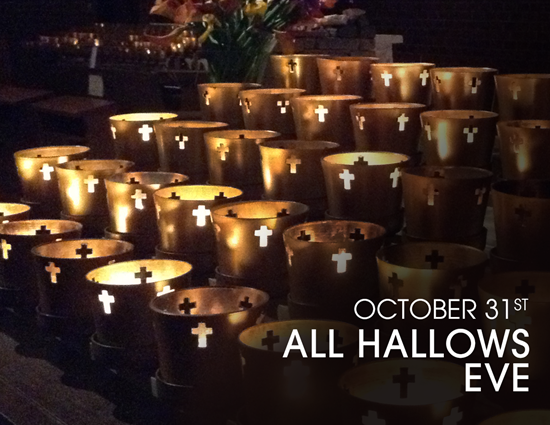
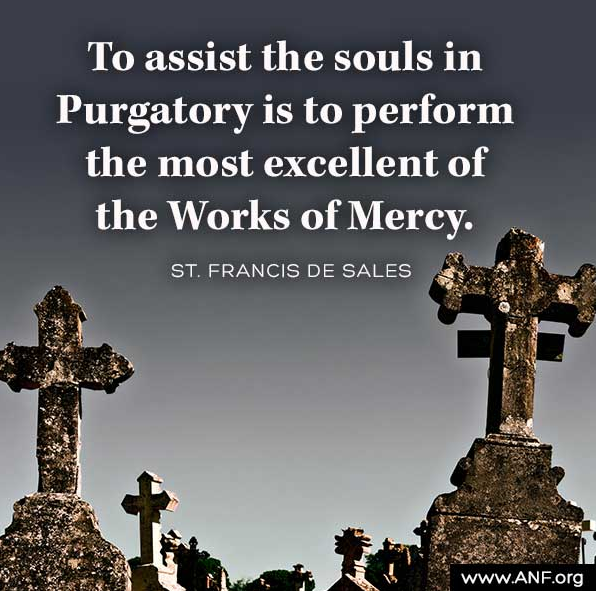
All Hallow's Eve, or Halloween, is the vigil of All Saints (All Hallows) Day, which is a major feast on the liturgical calendar and a Holy Day of Obligation. Halloween (October 31st) is connected with All Saints Day (November 1st) and All Souls Day (November 2nd). These three days are the "Days of the Dead," a triduum also known as Allhallowtide or Hallowmas, reminding the faithful of the reality of heaven and hell; the communion of saints; and our obligation to pray for the Holy Souls in Purgatory.
† Quote of the Day "Christ Himself is our mouth through which we speak to the Father, our eye through which we see the Father, our right hand through which we offer to the Father. Without His intercession neither we nor all the saints have anything with God." -St. Ambrose Today's Meditation "Let the sinner know that he will be tortured throughout all eternity, in those senses which he made use of to sin. I am writing this at the command of God, so that no soul may find an excuse by saying there is no hell, or that nobody has ever been there, and so no one can say what it is like. I, Sister Faustina, by the order of God, have visited the abysses of hell so that I might tell souls about it and testify to its existence." —St. Faustina Kowalska (741) Daily Verse "Bless those who persecute [you], bless and do not curse them. Rejoice with those who rejoice, weep with those who weep. Have the same regard for one another; do not be haughty but associate with the lowly; do not be wise in your own estimation. Do not repay anyone evil for evil; be concerned for what is noble in the sight of all. If possible, on your part, live at peace with all." -Romans 12:14-18 | St Wolfgang St. Wolfgang (934-994 A.D.), also known as the Great Almoner, was a Benedictine monk, reformer, and Bishop of Regensburg, Bavaria. He was born into the noble class and had an excellent education. As bishop he worked to reform the monasteries and convents in his diocese. He is remembered for his teaching abilities, his oratory skills, and his charity towards the poor. He was also integral in the missionary efforts to evangelize the Magyars in what is today modern Hungary. Towards the end of his life he withdrew to a solitary spot to build a church and hermitage at what is now called St. Wolfgang's Lake in Austria. Before settling he prayed and threw his axe into the wilderness, and built his cell on the spot where it landed. A town grew around the saint's hermitage which still exists today. According to legend, St. Wolfgang tricked the devil into helping him build the church, promising him the first soul that came through the church doors. The devil agreed, and after the construction was completed, a wolf was the first to cross its threshold, thus tricking the devil. St. Wolfgang's life was foundational to Bavarian and Austrian civilization. Many miracles occurred at his tomb, especially those related to stomach ailments. St. Wolfgang is the patron saint of carpenters, stroke victims, and the paralyzed. His feast day is October 31st.
Find a devotional for this saint | Friday of the Thirtieth Week in Ordinary Time Reading 1 Romans 9:1-5 Brothers and sisters:
I speak the truth in Christ, I do not lie;
my conscience joins with the Holy Spirit in bearing me witness
that I have great sorrow and constant anguish in my heart.
For I could wish that I myself were accursed and cut off from Christ
for the sake of my own people,
my kindred according to the flesh.
They are children of Israel;
theirs the adoption, the glory, the covenants,
the giving of the law, the worship, and the promises;
theirs the patriarchs, and from them,
according to the flesh, is the Christ,
who is over all, God blessed forever. Amen. Responsorial Psalm Psalm 147:12-13, 14-15, 19-20 R. Praise the Lord, Jerusalem.
Glorify the LORD, O Jerusalem;
praise your God, O Zion.
For he has strengthened the bars of your gates;
he has blessed your children within you. R. Praise the Lord, Jerusalem.
He has granted peace in your borders;
with the best of wheat he fills you.
He sends forth his command to the earth;
swiftly runs his word! R. Praise the Lord, Jerusalem.
He has proclaimed his word to Jacob,
his statutes and his ordinances to Israel.
He has not done thus for any other nation;
his ordinances he has not made known to them. Alleluia. R. Praise the Lord, Jerusalem. Alleluia John 10:27 R. Alleluia, alleluia.
My sheep hear my voice, says the Lord;
I know them, and they follow me.
R. Alleluia, alleluia. Gospel Luke 14:1-6 On a sabbath Jesus went to dine
at the home of one of the leading Pharisees,
and the people there were observing him carefully.
In front of him there was a man suffering from dropsy.
Jesus spoke to the scholars of the law and Pharisees in reply, asking,
"Is it lawful to cure on the sabbath or not?"
But they kept silent; so he took the man and,
after he had healed him, dismissed him.
Then he said to them
"Who among you, if your son or ox falls into a cistern,
would not immediately pull him out on the sabbath day?"
But they were unable to answer his question.
| Praise to You Oh Lord Jesus Christ! | Daily Meditation: Romans 9:1-5 . . . my own people, my kindred. (Romans 9:3) Today's first reading is the beginning of St. Paul's impassioned meditation on the mystery of Israel's rejection of Christ. How could so many people who had enjoyed God's special favor for centuries not recognize their Messiah when he arrived? How did they fail to see that Jesus was the fulfillment of the covenant that God had made with Moses and the summit of their entire history? These questions caused Paul to express "great sorrow and constant anguish"—especially since the answers were not readily apparent (Romans 9:2). Paul grew up a devout Jew and a member of the Pharisees. He also persecuted the early Christians. But that all changed when he encountered the risen Christ on his way to Damascus (Acts 9). That revelation proved to him that Jesus was the long-awaited Messiah. So imagine how hard it must have been for him, when he began preaching the gospel, to face so much hostility and rejection from the very people who once were his colleagues. Paul knew what his Jewish kin were missing—a life-changing encounter with Christ. His fellow Pharisees were devout, God-fearing men and women. They loved God and treasured his word. They devoted themselves to helping their people follow the Law of Moses. But so many of them just couldn't see how Jesus was the fulfillment of all their hopes and dreams. In the meantime, Paul was letting the Spirit open his eyes to the truth of Jesus' teachings. He was learning to lean on Jesus for grace in the face of temptations and hardships. And he was filled with joy at the knowledge that heaven had been opened for all who believe. Like Paul, we, too, may feel separated from loved ones who don't share our faith. We long for them to know how Jesus can change their lives. We want them to know how he can help them overcome sin and fill them with hope. We'll never know why some people accept Jesus while others don't. We'll never know why some of the people we love keep Christ at a distance. But Paul never gave up sharing his faith, and neither should you. Keep praying for your loved ones and keep sharing with them. And most of all, keep loving them! "Jesus, give me the courage and compassion of St. Paul." Psalm 147:12-15, 19-20
Luke 14:1-6 | Reflections with Brother Adrian: |  Ai Audio 2cents | From today's Holy Gospel: "....Jesus spoke to the scholars of the law and Pharisees in reply, asking,
"Is it lawful to cure on the sabbath or not?"
But they kept silent; so he took the man and,
after he had healed him, dismissed him.
Then he said to them
"Who among you, if your son or ox falls into a cistern,
would not immediately pull him out on the sabbath day?"
But they were unable to answer his question....." Word of the Lord. | Bishop:
"Friends, in today's Gospel, Jesus heals a man on the sabbath, thus demonstrating his authority over the law. The Jesus portrayed in the Gospels consistently speaks and acts in the very person of Yahweh, the God of Israel. On another occasion, defending his disciples against the charge of picking grain on the sabbath, Jesus reminds his interlocutors that priests serving in the temple can, under certain circumstances, violate the sabbath and still remain innocent. Then he adds with breathtaking laconicism, "I say to you, something greater than the temple is here." The only one who could reasonably claim to be "greater" than the temple would be the one who was worshiped in the temple. In a number of places in the Sermon on the Mount, Jesus states, "You have heard it said . . . but I say . . ." This almost casual dismissal of the Torah, the revelation given by Yahweh to Moses himself and hence the court of final appeal to any pious Jew, would have overwhelmed any first-century Jew. Once more, the only one who could legitimately overrule the Torah with such insouciance would be the one who was himself the author of the Torah." end quote.
To the Jews, our ancestors in faith, the Sabbath had become everything. The Sabbath was meant to honor and worship God Himself, but they failed to see God's will, God himself.
Can that happen to all of us?
And do we treat the Sabbath as honorable as it should be?
Nowadays, people say they "have a thing with God, a relationship, where they just pray alone on Sunday wherever and that's fine".
Is that what God wants?
You see how quickly we can lose touch with His will?
And the whole Sunday thing can be lost in an act of obedience. I can say a prayer with no heart. But God sees the heart!
This is how we are confused, and confusion is an antic that the evil likes to use, usually propagated through poor communication.
So what can we do? When in doubt...love. Trust in the Lord.
We are quick to judge. We can be quick tempered. Quick to anger. Quick to lash out. There are parishioners that, instead of finding the truth, immediately call the Bishop, or the cops, instead of working together, for a unified solution that God calls us to. The same happens in families, that, instead of being patient, they call the cops or call for a divorce. The same things happen in ministries, that instead of working things out, communication stops and divisions begin. Such lashings happened to Christ and still today. Because when we lash out at others, we lash out at Christ, and the lashings begin. And the hatred that whipped Christ and nailed Him to the Cross...continue until today.
We would be good, if we would listen with our hearts, and not with our minds, or eyes, or anything else, but listen...for God's quite, whispering voice that speaks so quietly, that only our consciousness can hear. And for that, we need grace, to have a well formed consciusness. |  Audio of Random Verse | Random Bible Verse 1 Kings 8:27 "But will God indeed dwell on the earth? Behold, heaven and the highest heaven cannot contain you; how much less this house that I have built!"
Word of the Lord! | If one day you don't receive these, just visit Going4th.com
God Bless You! Peace | | |







No comments:
Post a Comment